
Buying a mobile crusher isn't like buying a phone or clothes.
It's an investment of tens to hundreds of thousands of US dollars, to be used for ten to fifteen years. Choose the right one, and it will make you money every day; choose the wrong one, and it will burn through your savings every day.
Many customers making their first mobile crusher purchase make the mistake of focusing solely on price.
The machine may be cheap, but you'll find it lacks capacity, consumes too much fuel, doesn't screen properly, and breaks down frequently. In the end, it's cheap to buy, but expensive to operate.
This guide will help you avoid these pitfalls.
Step 1: Understand Your Project Needs
Before looking at equipment, ask yourself a few questions:
What materials are you crushing?
Granite, basalt, river pebbles? → Hard rock, requires a jaw crusher + cone crusher.
Limestone, bluestone? → Soft rock, a jaw crusher + impact crusher is sufficient.
Construction waste, concrete blocks? → Use an impact crusher with a magnetic separator.
What is the maximum particle size of your raw material?
Large stones over 800mm? → Choose a large jaw crusher (SE-1160, feed size 700mm)
Medium stones under 500mm? → Standard jaw crusher (SE-1060) or small jaw crusher (SE-650D)
Materials already coarsely crushed? → Use a cone crusher or impact crusher for secondary crushing
What is your required capacity?
50-130 tons/hour → Small project, SE-650D jaw crusher + small screening station
200-280 tons/hour → Medium project, SE-1060/SE-1160 jaw crusher + SY-HP300 cone crusher
Over 300 tons/hour → Large project, multiple machines operating together
What are the conditions of your work site?
Mountainous area, muddy terrain, steep slope? → Tracked equipment is required; wheeled equipment cannot access the area.
Fixed material yard, smooth roads? → Tracked or modular equipment is acceptable.
Do you need frequent relocation? → Tracked self-propelled crushers are the most convenient.
Step 2: Choosing the Right Crushing Equipment Combination
Different projects require completely different equipment combinations.
Hard Rock Crushing (Granite, Basalt)
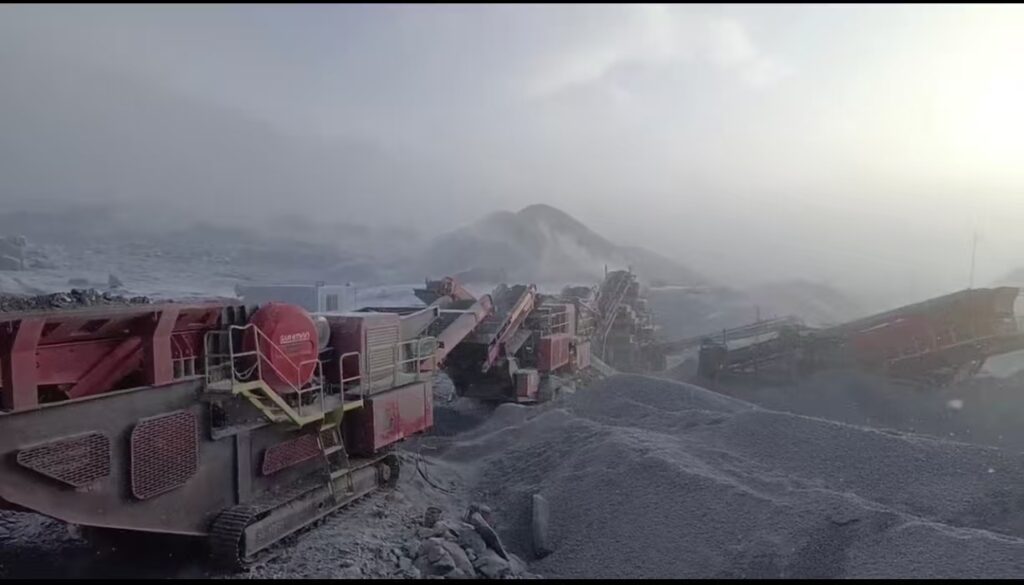
Recommended Solution: Jaw Crusher + Cone Crusher + Mobile Screening Station
The jaw crusher performs primary crushing, breaking large stones into medium-sized particles; the cone crusher performs secondary crushing, breaking medium-sized materials into finished aggregates; the screening station separates aggregates of different sizes.
Dainamu Solution: SE-1160 Mobile Jaw Crusher + SY-HP400 Mobile Cone Crusher + SS-7018 Mobile Screening Station
Soft Rock Crushing (Limestone, Bluestone)
Recommended Solution: Jaw Crusher + Impact Crusher
An impact crusher is sufficient for soft rock. Impact crushers produce good particle shape and uniform output, and the cost of wear parts for impact crushers is lower than that of cone crushers.
Dainamu Solution: SE-1060 Mobile Jaw Crusher + SF-580D Mobile Impact Crusher
Construction Waste Recycling
Recommended Solution: Impact Crusher + Magnetic Removal Device + Screening Station
Construction waste contains reinforcing bars and wires, so a magnetic removal device is essential. Impact crushers are most effective at crushing concrete blocks, and the output can be directly used as recycled aggregate.
Dainamu Solution: SF-380D Mobile Impact Crusher + SS-7018 Mobile Screening Station
Mud and Stone Separation/Pre-screening
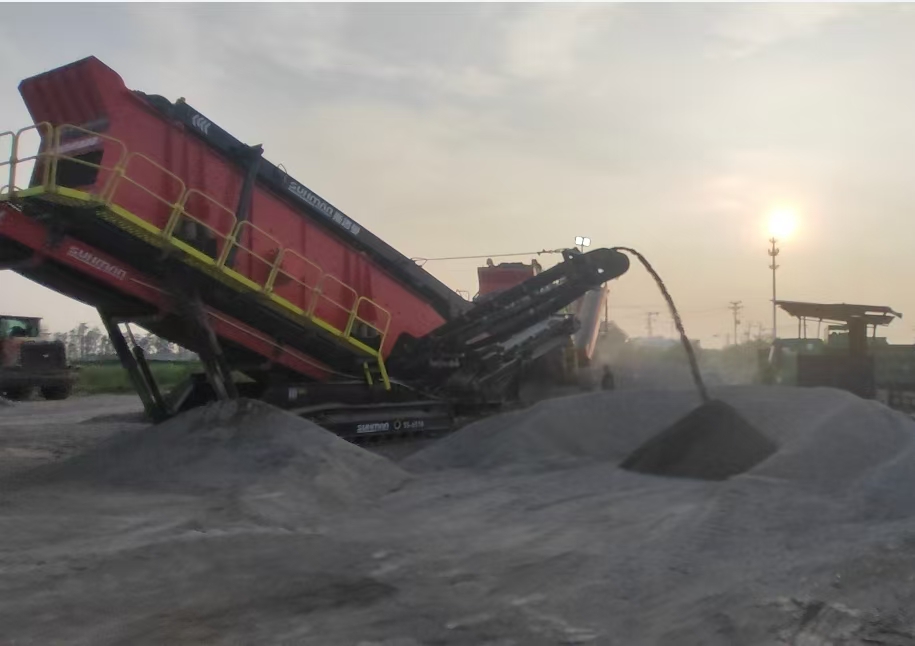
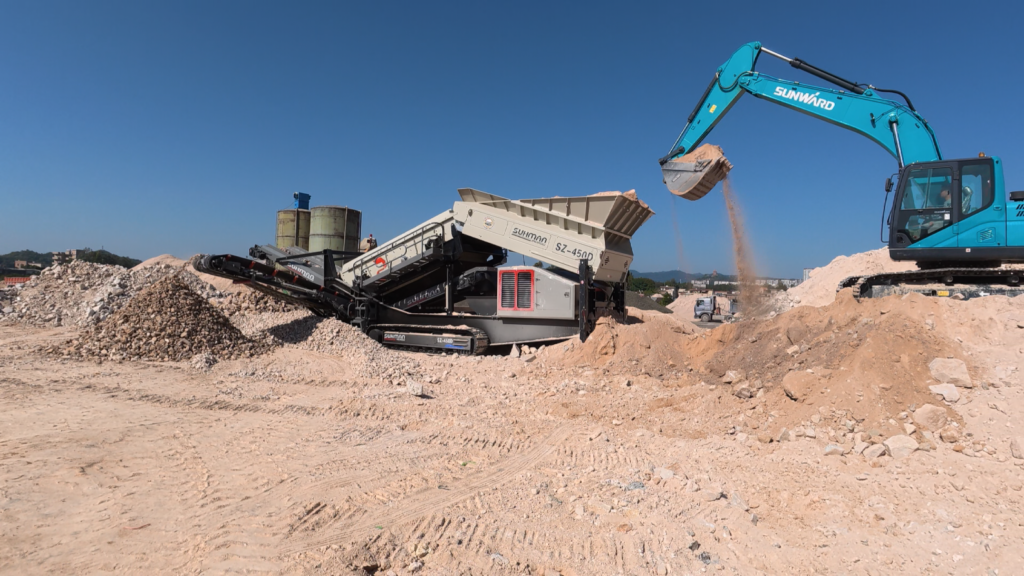
Recommended Solution: Heavy Screening Machine (Pre-screening Machine)
If the raw material has a high mud content and high moisture content, use a heavy screening machine to remove mud and fine materials before feeding it into the crusher. This protects downstream equipment and improves overall line efficiency.
Dainamu Solution: SZ-450D Mobile Heavy Screening Machine
Step 3: Examine Core Configuration, Don't Be Fooled by Low Prices
Once the equipment selection is determined, the next step is to examine the configuration. The same jaw crusher can have a price difference of tens of thousands depending on the configuration, resulting in a difference in operating costs of hundreds of thousands.
Motor – Check Energy Efficiency Rating
The motor accounts for over 80% of the total energy consumption of a crusher. A 75kW machine running 2000 hours a year with a YE3 high-efficiency motor saves over 9000 kWh annually compared to the older YE2 model, saving over 7000 RMB. Over 15 years, this translates to savings of over 300,000 RMB in electricity costs.
The entire Dainamu series comes standard with a YE3 high-efficiency motor, not because we're generous, but because the YE2 has been obsolete in China since 2021.
Hydraulic System – Check if it's Fully Hydraulic
A fully hydraulic system means that the crawler self-propelled movement, hopper folding, and conveyor belt folding are all hydraulically driven, requiring no external power source. The equipment is ready to work on-site, simply set up. Relocation is straightforward; it can be driven away automatically without waiting for a crane.
The entire Dainamu series uses a fully hydraulic system, allowing one person to operate the entire machine.
Component Brand – Check Core Components
Hydraulic pumps, bearings, seals, and electrical components – these are the key factors determining the equipment's lifespan. The whole machine was tens of thousands cheaper, but the bearings needed replacing three times a year, and the seals leaked oil daily. In the end, you still lost money.
Dainamu uses SKF/FAG grade bearings, top-tier domestic brands for hydraulic components, and Siemens/Schneider equivalent electrical components. Is it expensive? A little more. But the equipment runs for ten years without major problems, which is true cost-saving.
Step 4: Calculate the Total Cost, Don't Just Look at the Purchase Price
The cost of buying equipment is not just the purchase price.
Total Cost of Ownership = Purchase Price + Transportation Cost + Installation and Commissioning Cost + Electricity Cost + Parts Wear and Tear Cost + Repair Cost + Downtime Loss
A cheap machine may:
High electricity costs (low motor efficiency)
Expensive parts (difficult to find generic parts)
Frequent downtime (high failure rate, production delays)
Short lifespan (obsolete after 5 years)
A good machine may:
Low electricity costs (saving thousands annually with YE3 motors)
Cheap parts (standard parts readily available)
Few downtimes (stable operation)
Long lifespan (no problems for 15 years)
The purchase price difference may only be tens of thousands, but the total cost difference over 15 years can be hundreds of thousands.
Step 5: Choosing the right manufacturer is more important than choosing the right equipment
Even the best equipment is useless if the manufacturer is bad.
What should you look for in a manufacturer?
Do they have their own factory?
Trading companies and equipment manufacturers are completely different. Trading companies don't care after the sale, while manufacturers have after-sales teams, parts warehouses, and remote technical support.
Dainamu has its own production base in Hefei, Anhui, within the China Ordnance Factory Industrial Park. It offers a complete service chain from production to after-sales support.
Check for successful case studies.
Don't listen to the manufacturer's claims; visit customer sites. Dainamu's equipment is exported globally, and you can visit and inquire about every case study.
Check for after-sales service.
Equipment you buy will last for over a decade; inadequate after-sales service is like buying a ticking time bomb. Dainamu offers:
Dedicated one-on-one customer service
On-site installation guidance
Operation training
Free spare parts included with shipment
Summary: 5 Key Points for Choosing a Mobile Crusher
Clarify Needs: Understand your materials, capacity, and site requirements before selecting equipment.
Optimal Combination: Jaw crusher + cone crusher for hard rock; jaw crusher + impact crusher for soft rock; impact crusher for construction waste.
Consider Configuration: YE3 motor, full hydraulic system, and brand-name parts are essential.
Calculate the Total Cost: The purchase price is just the tip of the iceberg; the total cost over 15 years is crucial.
Choose a Manufacturer: Manufacturers with their own factories, successful case studies, and comprehensive after-sales service.
Want to know if Dainamu's mobile crushing and screening equipment is suitable for your project?
We offer free selection solutions, capacity calculations, and detailed quotes.
Mobile/WhatsApp: +86 15385175652
Email: chinadainamu@gmail.com
Factory: No. 43 Tangkou Road, Feixi Economic Development Zone, Hefei City, Anhui Province
Dainamu — Austrian technology, Chinese manufacturing, YE3 high-efficiency motor as standard, worldwide shipping.