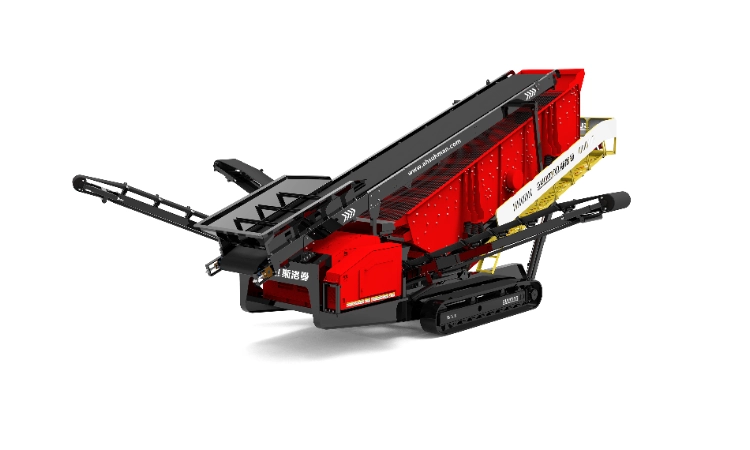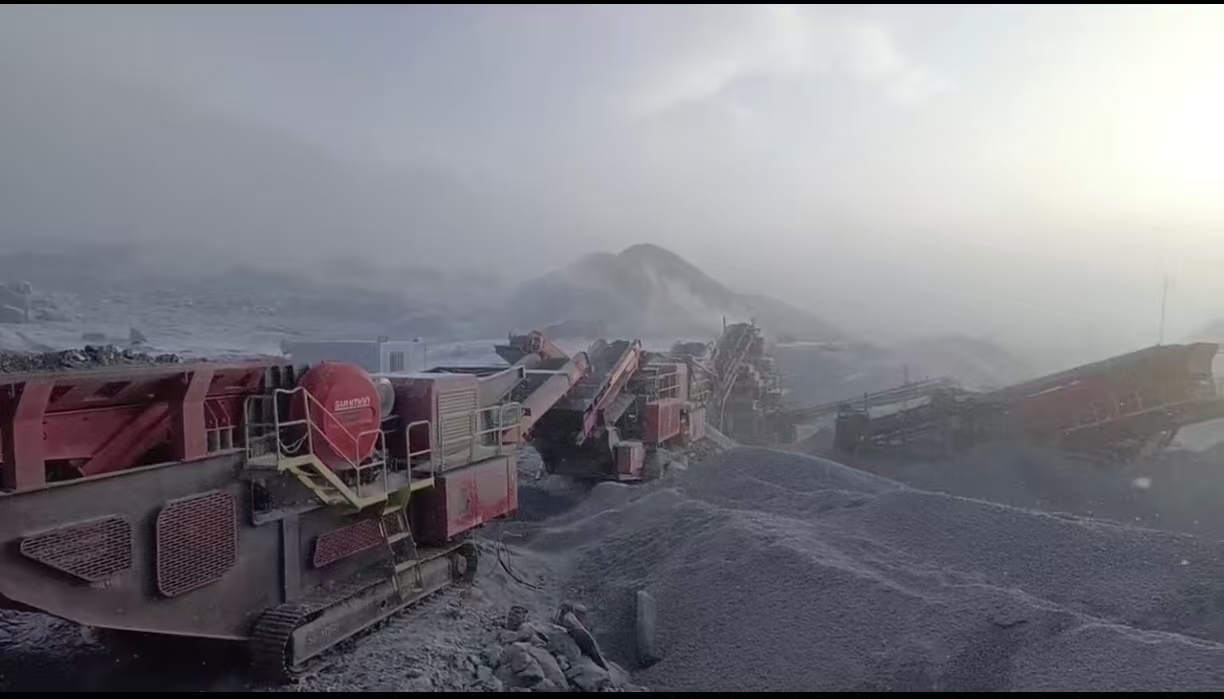
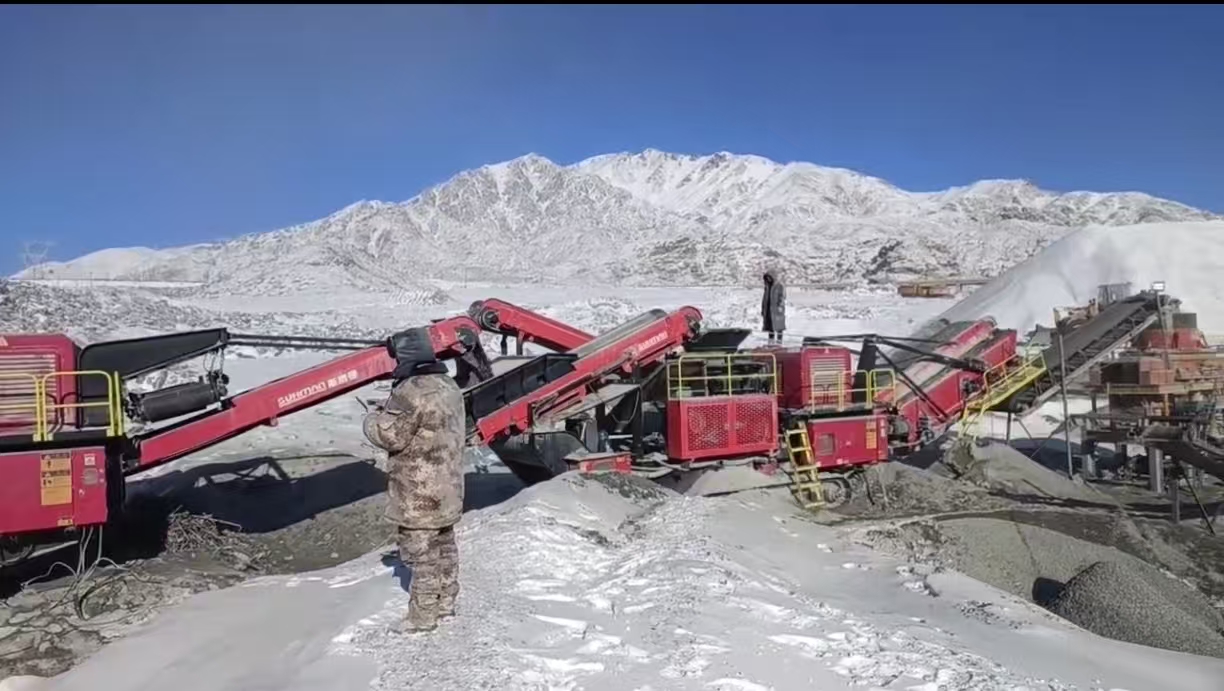
At 6:00 AM, in Mohe, Heilongjiang Province,Dainamu mobile crusher is working, the temperature was -38 degrees Celsius. Distant mountains were covered in snow, and breath instantly froze into frost. At an iron ore mining site, a tracked mobile crushing machine was operating smoothly, feeding large 700mm iron ore chunks into the feed inlet. After coarse crushing by a jaw crusher, fine crushing by a cone crusher, and vibrating screening, it finally produced finished ore in three sizes: 0-10mm, 10-25mm, and 25-40mm.
This is a customized crushing production line for extremely cold regions, custom-designed by DAINAMU for a mining company in Heilongjiang. The equipment went into operation before the winter of November 2024 and had completed two heating seasons by March 2026, processing an average of 1800 tons of iron ore per day. Key performance indicators such as equipment start-up time, hydraulic system response, and wear part life all met design requirements.
Please click to view the video.
This article doesn't discuss parameter optimization; instead, it talks about the pitfalls of crushing equipment in extremely cold regions and how we solved them. If you are working in extreme environments such as high latitudes and high altitudes, or are worried about your equipment's performance in winter, hopefully this will provide some helpful information.
I. The Real Problem Encountered by the Client
The client had been engaged in iron ore mining in the Greater Khingan Mountains of Heilongjiang Province for over ten years. In 2024, facing equipment upgrades, they shared some thoughts that left a deep impression on me:
"Our previous fixed production line would break down every winter. The hydraulic oil would freeze, the steel would crack, and the diesel fuel would solidify. Production was essentially halted from November to March of the following year. You know, in Northeast China, you can't work for five months in winter; the losses are enormous."
"The new mine is north of Mohe, where winter temperatures can drop to -42 degrees Celsius. We consulted several manufacturers; some claimed they could operate at -30 degrees Celsius, but in reality, they had difficulty starting at -20 degrees Celsius; some offered very low prices, but we were hesitant to use them in extremely cold regions for fear of delaying the project." Ultimately, the client chose DAINAMU, citing three reasons: firstly, our official certification allows for operation at -40 degrees Celsius. The ability to operate at low temperatures is not just talk; secondly, there is measured data on the anti-brittle fracture performance of high-chromium steel at low temperatures; thirdly, the hydraulic system has a dual optimization scheme of low-temperature start-up and high-temperature heat dissipation, not just a simple addition of a heater.
II. What problems are prone to occur with equipment in extremely cold environments?
In Mohe, the winter climate has several characteristics that test the equipment:
The lowest temperature can reach -42 degrees Celsius. At this temperature, ordinary steel becomes brittle and easily cracks upon impact. Hydraulic oil viscosity increases, its fluidity decreases, and starting becomes difficult. Diesel fuel can solidify, preventing engine ignition.
The diurnal temperature range can exceed 20 degrees Celsius, accelerating the aging of seals and increasing the risk of oil leaks.
Snow depth can reach 1 to 2 meters, posing challenges to equipment movement and site clearing.
Winter lasts from November to March of the following year, requiring equipment to operate continuously at low temperatures for five months, not just for a day or two.
Our technical engineers explained to me that equipment failure in extremely cold regions is mainly due to three reasons: first, the steel becomes brittle at low temperatures, making it prone to cracking upon impact; second, the hydraulic oil viscosity increases, reducing its fluidity and making starting difficult; and third, the diesel fuel solidifies, preventing the engine from igniting. If these three problems are not solved, the equipment is just scrap metal.
III. How We Solved These Problems
For the extreme cold environment of -40 degrees Celsius and the characteristics of iron ore, we offer the following configuration:
SE-1060 Tracked Mobile Jaw Crusher (Low Temperature Version)
Feed size up to 700mm, discharge opening adjustable from 50-150mm. The frame uses 20mm thick high-chromium alloy steel, maintaining an impact toughness of over 27 Joules even at -50 degrees Celsius. The jaw plates are made of high-chromium cast iron with low-temperature heat treatment, maintaining a hardness above HRC55 even at -40 degrees Celsius. The hydraulic system uses low-temperature hydraulic oil with a pour point of -45 degrees Celsius and is equipped with an oil tank heating device. The diesel generator set uses -35 diesel fuel and features a preheating system and a large-capacity battery.
As an aside, ordinary Q235 steel experiences a sharp decrease in impact toughness below -20 degrees Celsius, while high-chromium alloy steel maintains good toughness at -50 degrees Celsius and does not crack during long-term operation. This isn't just boasting; there are actual test reports to back it up.
The SY-HP300 tracked mobile multi-cylinder hydraulic cone crusher (low-temperature version) features independent oil temperature control in its hydraulic system, allowing for preheating at low temperatures and heat dissipation at high temperatures. The seals use low-temperature resistant silicone, which does not harden at -45 degrees Celsius. The lubrication system uses low-temperature lubricating oil and includes an electric heating device.
Why use a cone crusher for iron ore? Iron ore has high hardness, with a Mohs scale of 6-7, causing rapid wear on the impact crusher's hammer plates. The cone crusher uses layered crushing, breaking the material along natural fissures, resulting in less wear and greater stability in low-temperature environments. This is a conclusion drawn from years of experience, not a decision made on a whim.
SS-7018 Tracked Mobile Vibrating Screen (Low Temperature Version)
Three-layer screen with screen apertures of 40mm, 25mm, and 10mm. The vibrating motor is a low-temperature specialized motor, capable of starting normally at -40°C. The screen material is spring steel with low-temperature treatment, ensuring it won't break at -40°C. Low-temperature grease is used for bearing lubrication, maintaining fluidity even at -45°C.
Extreme Cold Support System
Diesel preheating uses a fuel heater and insulated fuel tank to prevent diesel fuel from solidifying. Hydraulic preheating uses electric heating and a circulating pump to preheat hydraulic oil before low-temperature startup. Battery insulation includes an insulated box and heating elements to maintain battery operating temperature. The cab has an independent heating system for operator comfort. The tracks use a special rubber compound that maintains flexibility even at -40°C.
IV. Real-world data from the past four months of operation
After the equipment was put into operation, we recorded operating data weekly. Here is a summary of the past four months:
Startup Performance:
--10°C to -20°C: Normal startup, starts within 30 seconds, 100% success rate.
--20°C to -30°C: 5-minute warm-up, starts within 1 minute, 100% success rate.
--30°C to -40°C: 10-minute warm-up, starts within 2 minutes, 100% success rate.
--40°C: 15-minute warm-up, starts within 3 minutes, 100% success rate.
The customer told me, "The startup performance exceeded expectations. The previous machine wouldn't start at -25 degrees Celsius, requiring daily heating of the oil tank and hot water. This machine starts in just 10 minutes of preheating, saving a lot of trouble." Regarding production capacity: In November 2025, the average temperature was -15 degrees Celsius, with an average hourly output of 210 tons, a daily output of 2100 tons, and 25 working days. In December, the average temperature was -28 degrees Celsius, with an average hourly output of 200 tons, a daily output of 2000 tons, and 26 working days. In January 2026, the average temperature was -35 degrees Celsius, with an average hourly output of 190 tons, a daily output of 1900 tons, and 24 working days. In February, the average temperature was -32 degrees Celsius, with an average hourly output of 195 tons, a daily output of 1950 tons, and 22 working days. The average temperature in March was -18 degrees Celsius, with an average hourly output of 205 tons, a daily output of 2050 tons, and 25 working days.
The customer stated, "Production capacity is indeed affected by the low temperatures, but the impact is not significant. At the coldest point, the hourly output was 190 tons, about 10% lower than in summer, which is acceptable. The key is continuous operation without frequent shutdowns." Regarding the lifespan of wear parts: The jaw crusher tooth plate has a designed lifespan of 700 hours, with an actual usage of 750 hours, and a usable lifespan of 900-1000 hours at room temperature. The cone crusher jaw wall has a designed lifespan of 1000 hours, with an actual usage of 1100 hours, and a usable lifespan of 1300-1500 hours at room temperature. The cone crusher crushing wall has a designed lifespan of 1000 hours, with an actual usage of 1150 hours. The screen has a designed lifespan of 500 hours, with an actual usage of 550 hours.
Low temperatures have some impact on the lifespan of wear-resistant parts, but high-chromium materials maintain good hardness at low temperatures, with wear increasing by less than 20%, far below the industry average.
Hydraulic System Performance: Low-temperature start-up oil temperature is -35°C; it operates normally after preheating. Normal operating oil temperature is 45-60°C; it runs smoothly after stabilization. The high-temperature protection threshold is 75°C, with automatic alarm. The hydraulic oil replacement cycle is 1000 hours, the same as at room temperature.
The customer stated: "The hydraulic system is very stable. Even at the coldest temperature of -38°C, it only needs 10 minutes of preheating to operate normally, without any jamming or oil leakage issues."
V. Actual Measurement in Extreme Cold Weather of -42°C: In mid-January 2026, Mohe experienced extremely cold weather, with a minimum temperature of -42°C, remaining below -40°C for five consecutive days.
On January 12th, the minimum temperature was -38°C; it operated normally after 10 minutes of preheating. On the 13th, the lowest temperature was -40 degrees Celsius, and the machine operated normally with a 12-minute preheating period. On the 14th, the lowest temperature was -42 degrees Celsius, and the machine operated normally with a 15-minute preheating period. On the 15th, the lowest temperature was -41 degrees Celsius, and the machine operated normally with a 12-minute preheating period. On the 16th, the lowest temperature was -39 degrees Celsius, and the machine operated normally with a 10-minute preheating period.
The customer told me, "We didn't expect it to operate normally at -42 degrees Celsius. The previous machine broke down at -30 degrees Celsius. This time, with the extreme cold, many mines in the surrounding area stopped production, but we were able to continue production normally without delaying the project schedule."
VI. How does the same machine perform in summer?
Before being put into production in August 2024, this machine underwent high-temperature testing at the Hefei factory in Anhui. It operated normally for 8 hours at an ambient temperature of 45 degrees Celsius. The hydraulic system automatically cooled down when the oil temperature reached 70 degrees Celsius, stabilizing at 60 degrees Celsius. The electrical system operated under continuous high load without triggering overheat protection.
The engineer told me, "The same equipment can operate from 45 degrees Celsius to -40 degrees Celsius. The key is that the system design considered all temperature range conditions; it's not simply a matter of adding a heater."
VII. Customer Feedback
The customer's equipment director summarized several points for me:
Reliable start-up in extreme cold. It starts up in 10 minutes at -40 degrees Celsius. The previous equipment couldn't start at -25 degrees Celsius, requiring daily heating of the oil tank and boiling of hot water.
Steel resistance to brittleness. The 20mm high-chromium frame is indeed sturdy. It operated continuously for 4 months at -40 degrees Celsius without cracking or deformation.
Stable hydraulic system. Even at the coldest temperature of -42 degrees Celsius, the hydraulic system still functioned normally without jamming or leaks.
Year-round usability. It can operate in summer temperatures of 40 degrees Celsius and winter temperatures of -40 degrees Celsius, eliminating the need for winter shutdowns. This allows for an extra 3 months of production per year, significantly increasing profits.
Excellent after-sales service. After-sales service is crucial in extremely cold regions; a rapid response to any issues is essential.
VIII. Some Suggestions for Those Buying Extreme Cold Equipment
Based on this project experience, I have summarized the following suggestions for your reference:
The type of steel used determines the lifespan of the equipment. Low-temperature steel must be used in extremely cold regions. Ordinary steel experiences a sharp decrease in impact toughness below -20°C, making it prone to brittleness. High-chromium alloy steel maintains good toughness even at -50°C.
The hydraulic system is critical. Low-temperature hydraulic oil has a freezing point of -45°C. Combined with tank heating and circulation preheating, all three are indispensable. Simply adding a heater has limited effect.
The diesel fuel grade must be matched. Use -10 diesel fuel above -20°C, -20 diesel fuel between -20°C and -30°C, and -35 diesel fuel below -30°C, in conjunction with the preheating system.
Seals cannot be overlooked. Ordinary rubber seals harden and fail below -30°C, requiring the use of low-temperature resistant silicone seals that maintain elasticity at -45°C.
Battery insulation is crucial. Low-temperature batteries experience a capacity reduction of over 50%, necessitating the use of insulated boxes with heating elements to maintain battery operating temperature.
A full-temperature-range design is more economical. If equipment needs to be used in different seasons and regions, choosing a full-temperature-range design allows operation from -40°C to 45°C, avoiding redundant investment.
IX. A Few Final Words Crushing operations in extremely cold regions are the ultimate test of equipment performance. DAINAMU has been deeply involved in the mobile crushing and screening industry for many years, providing specialized crushing solutions for customers in high-altitude and cold regions such as Heilongjiang, Inner Mongolia, Xinjiang, and Qinghai.
The Mohe, Heilongjiang case is just one of DAINAMU's many extreme cold projects. Our equipment operates stably across a full temperature range from -40°C to 45°C, adapting to various extreme environments.
If you are operating in extreme environments such as high latitudes or high altitudes, please contact us. We offer free technical consultation, on-site environmental assessment, customized solution design, equipment operation training, and after-sales maintenance support.
The quality of our equipment is truly tested in extreme environments.
Hotline: +86 13655601121 (WhatsApp)
Email: suhmanhf@gmail.com
Production Base: No. 43 Tangkou Road, Feixi Economic Development Zone, Hefei City, Anhui Province