
Dainamu want to let you know:Crusher Working Principle and Selection Guide - Dainamu Mobile Crushing Plant Manufacturer, China.
I. What is a Crusher?
A crusher is a device that breaks large rocks, concrete, or ores into smaller aggregates, gravel, or stone powder.
This size reduction process allows contractors to transform raw materials into usable aggregates—a core component of road construction, asphalt production, and concrete mixing. Crushes achieve this by applying mechanical force (compression, impact, or grinding) within a crushing chamber.
Modern crushers are widely used in mining, building aggregate production, infrastructure construction, and solid waste recycling, serving as the "heart" of material processing lines.
II. Crusher Working Principle
| Crushing Method | Principle | Applicable Materials | Representative Machine Models |
| Compressive Crushing | Continuous compression between two surfaces causes material to fracture | Hard rock, highly abrasive materials | Jaw crusher, cone crusher |
| Impact Crushing | High-speed collision; material is crushed under instantaneous impact force | Medium-hard rock, soft rock, construction waste | Impact crusher, sand making machine |
| Grinding Crushing | Friction and grinding between two surfaces of material | Low-abrasive materials | Some tertiary crushing equipment |
| Shear Crushing | Cutting method, usually combined with other methods | Medium-hardness materials | Roller Crusher |
Dainamu Technology Tip: Extrusion crushing (jaw crusher, cone crusher) is suitable for hard rock (granite, basalt, river pebbles), while impact crushing (impact crusher) is suitable for medium-hard rock and construction waste recycling. Choosing the correct crushing principle directly affects the crushing ratio, wear part life, and overall production efficiency.
III. Detailed Explanation of Crushing Stages
Primary Crushing
Function: The first stage of crushing, reducing the large raw materials (up to 1270mm) after blasting to a processable size (approximately 500mm).
Core Equipment: Jaw crusher, gyratory crusher
The primary crusher is the "gateway" of the entire production line, directly handling the largest and hardest raw materials. The equipment must have sufficient strength and feed opening size to efficiently process untreated blasted materials.
Secondary Crushing
Function: Further reducing the material after primary crushing (approximately 330mm) to below 100mm.
Core Equipment: Cone Crusher, Impact Crusher
Secondary crushing focuses on particle shape and gradation control, a crucial step in determining the final aggregate quality. Cone crushers emphasize fine crushing of hard rock, while impact crushers excel in improving particle shape.
Tertiary Crushing
Function: Achieves fine crushing, producing high-quality aggregates of 25-125mm.
Core Equipment: Small Cone Crusher, Virtual Solid Injector (VSI)
Tertiary crushing has extremely high requirements for particle shape. Products are typically used in applications such as asphalt and concrete where strict requirements on aggregate shape are necessary. VSI sand making machines produce cubic aggregates with excellent particle shape, making them ideal for high-quality manufactured sand.
IV. Detailed Explanation of Mainstream Crusher Types
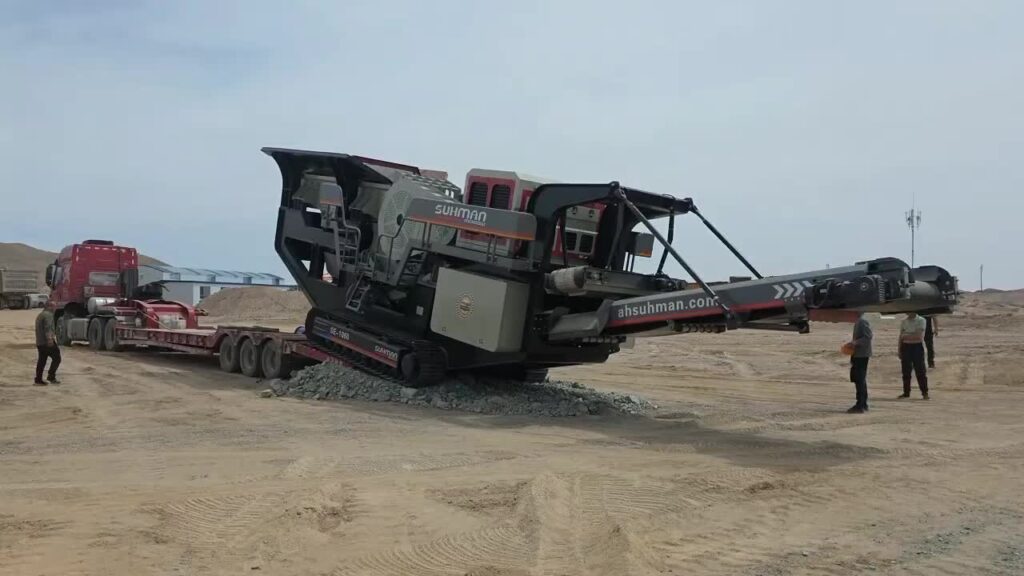
Working Principle: Material is crushed by compression between a fixed jaw plate and a movable jaw plate. The movable jaw plate, driven by an eccentric shaft, reciprocates, generating a powerful compressive force on the material.
Classification:
Single-Toggle Jaw Crusher: The top eccentric shaft rotates in conjunction with the toggle plate to generate compression, resulting in high capacity and simple maintenance. All Dainamu jaw crushers use a single-toggle plate design.
Double-Toggle Jaw Crusher: Two shafts and two toggle plates provide greater crushing force, but the structure is more complex, and the capacity is relatively lower.
Features:
- Mainly used for primary crushing
- Simple structure, easy maintenance
- Long service life of manganese steel wear-resistant parts
- Large crushing ratio, high capacity
- Product particle shape is angular, not suitable for scenarios with high particle shape requirements
Applicable materials: Granite, basalt, andesite, river pebbles, iron ore, and other hard rocks
Click to view video
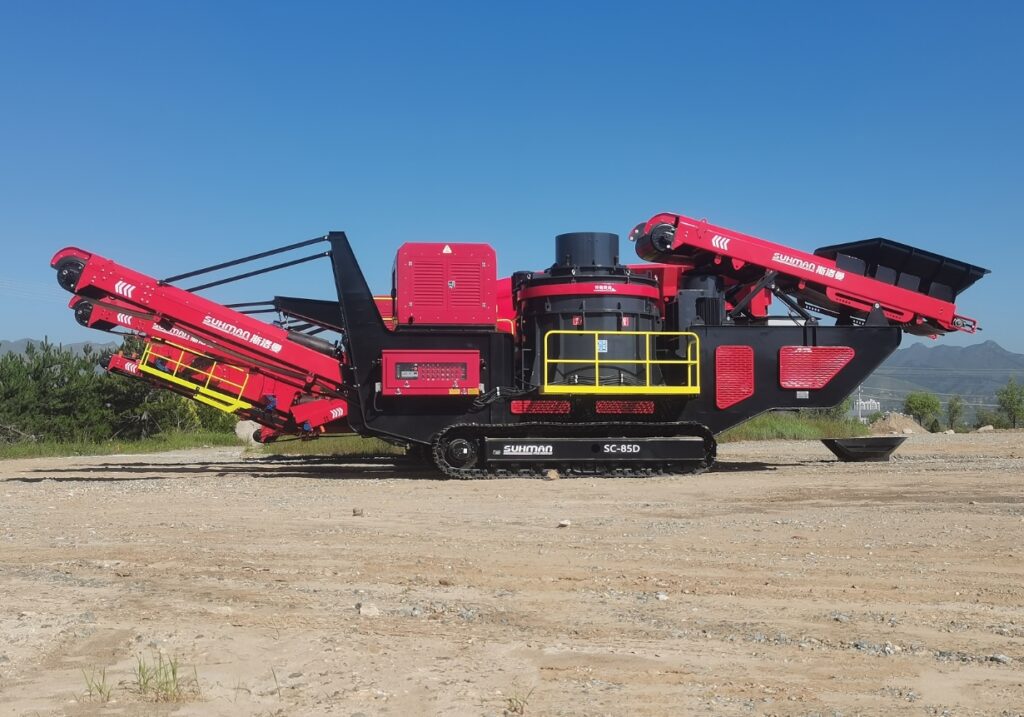
Working Principle: The eccentric shaft is driven by gears, causing the crushing cone to oscillate within a fixed bowl-shaped liner. The material is continuously crushed and compressed within the crushing chamber, while the material particles collide with each other (layer crushing), further improving crushing efficiency and reducing liner wear.
Features:
- Mainly used for secondary and tertiary crushing.
- Hydraulic discharge port adjustment allows for controllable product particle size. Full-feed operation improves particle shape. Long wear-resistant parts life and low operating costs.
- Not suitable for sticky materials or materials with high mud content.
Applicable materials: Medium-hard to hard rocks such as granite, basalt, and iron ore.
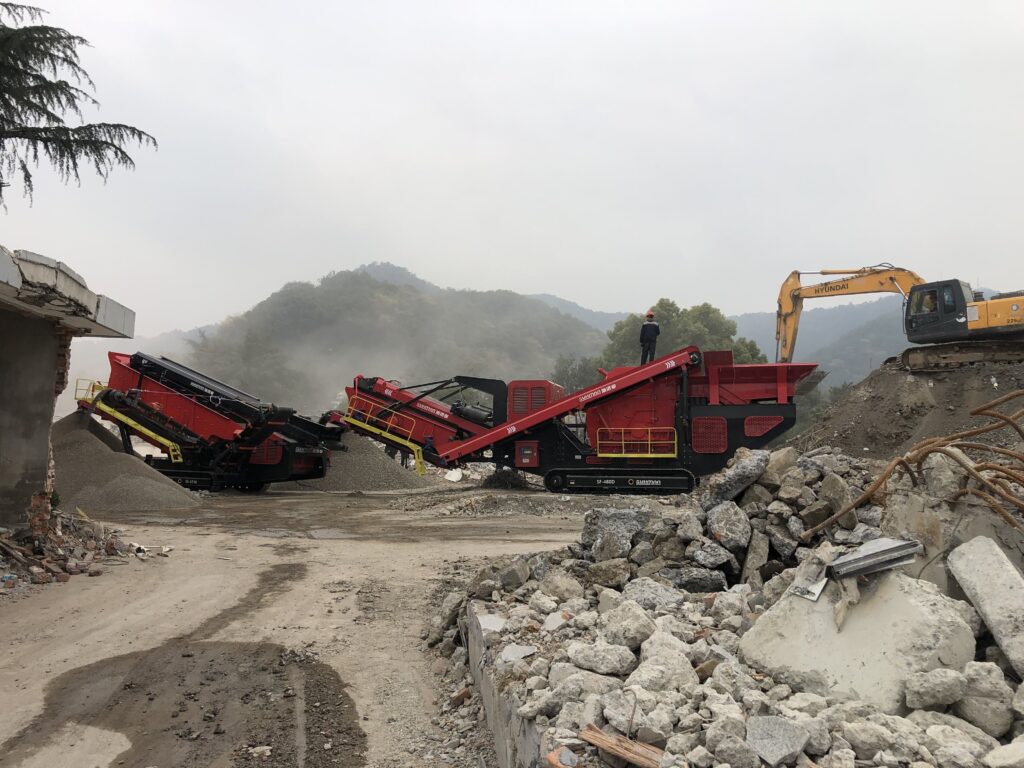
Working principle: Utilizing high-speed rotating rotors and hammers, the material is subjected to high-intensity impact force. After being thrown out, the material collides with the crushing chamber walls and further crushes itself within the chamber.
Classification:
HSI (Horizontal Axis Impact Crusher): Large crushing ratio, good particle shape, can process medium-hard rock → Primary/Secondary/Tertiary crushing
VSI (Vertical Axis Impact Crusher): Precise cubic product, fine aggregate production → Tertiary/Shaping crushing
Features:
- Excellent product particle shape (cubic), suitable for concrete and asphalt
- Can process soft and medium-hard rock
- Preferred equipment for construction waste recycling
- Integrated crushing and screening machine can produce multiple specifications of finished products in one pass
- Faster wear parts consumption for hard rock (granite, basalt)
Applicable materials: Limestone, bluestone, dolomite, construction waste, concrete blocks
V. Jaw Crusher vs. Impact Crusher: Product Particle Shape Comparison
| Comparison Items | Jaw Crusher | Impact Crusher |
| Crushing Principle | Compressed Crushering | Impact Crushering |
| Product Particle Shape | Angular, Flat | Uniform, Cubic |
| Crushing Stages | Primary Crushing | Secondary/Third-Level Crushing |
| Applicable Materials | Hard Rock (Granite, Basalt) | Medium-Hard Rock, Soft Rock, Construction Waste |
| Wear Parts Consumption | Low (Long life of manganese steel) | Higher (Hammer Plate/Impact Plate) |
| Typical Applications | Roadbed, Backfill, Coarse Aggregate | Concrete, Asphalt, High-Quality Aggregate |
Selection Recommendations: If only size reduction is required (e.g., roadbed backfill), a jaw crusher is an economical and efficient choice. If high-quality cubic aggregate is required (e.g., ready-mixed concrete, asphalt), an impact crusher or VSI crusher is a better choice. In actual production lines, the combination of jaw crusher + cone crusher/impact crusher is most common.
VI. How to Choose the Right Crusher?
- Material Characteristics
Hardness: For hard rock, use compression crushers (jaw crushers, cone crushers); for medium-hard and soft rock, use impact crushers (impact crushers).
Abrasiveness: For highly abrasive materials, jaw crushers and cone crushers are preferred.
Mud/Moisture Content: Sticky materials are not suitable for cone crushers; jaw crushers or impact crushers are preferable.
- Crushing Stages
Primary Crushing: Jaw crusher, gyratory crusher
Secondary Crushing: Cone crusher, impact crusher
Tertiary Crushing/Shaping: VSI (Vacuum-Insulated Sand Making Machine), small cone crusher
- Mobile vs. Fixed
Mobile Crushing Plant (tracked): Suitable for variable site conditions, on-site operations, and construction waste recycling.
Fixed Crushing Line: Suitable for large mines, long-term fixed operations, and ultra-high capacity requirements.
- Operating Costs
- Consider the frequency and cost of wear parts replacement.
- Consider energy consumption and output.
- Consider maintenance and downtime.
VII. Crushing Line Configuration Recommendations
| Application Scenarios | Recommended Configuration | Product Applications |
| Hard Rock Aggregate Production | Jaw Crusher → Cone Crusher → Cone Crusher/Screening | Concrete Aggregate, Asphalt Aggregate |
| Medium-Hard Rock/Limestone | Jaw Crusher → Impact Crusher → Screening | Premium Aggregate, Commercial Aggregate |
| Construction Waste Recycling | Impact Crusher → Magnetic Remover → Screening | Recycled Aggregate, Raw Material for Non-Fried Bricks |
| Artificial Sand Production | Jaw Crusher → Cone Crusher → VSI Sand Making Machine | High-Quality Manufactured Sand |
| Small Mobile Operation | Small Jaw Crusher + Small Cone Crusher/Impact Crusher | Flexible relocation, multi-scenario operation |
VIII. Crusher Maintenance Points
Regular inspection of wear parts: Jaw plates, jaw walls, hammers, and other wear parts need regular inspection and replacement.
Hydraulic system maintenance: Keep hydraulic oil clean and regularly inspect seals.
Lubrication maintenance: Lubrication of key components such as bearings and gears is the foundation for long-term stable operation of the equipment.
Feed control: Uniform and continuous feeding to prevent excessively large materials and metal foreign objects from entering the crushing chamber. Full-feed operation: It is recommended to use full-feed operation for cone crushers and impact crushers to improve particle shape and reduce wear.
IX. Dainamu's Core Advantages
Military-grade quality
Produced at a Chinese military factory, adhering to military-grade quality standards, ensuring extremely high reliability, durability, and stability of the equipment.
Complete product line
22 products covering the entire crushing process from primary to tertiary, meeting the needs of mining, construction aggregates, infrastructure, solid waste treatment, and other scenarios.
Tracked Mobile Crushing Technology
The entire series of mobile crushing plants adopts a tracked chassis design, adapting to complex terrain, steep slopes, and narrow mine tunnels. Production can begin immediately upon stopping, requiring no foundation installation.
Comprehensive After-Sales Service
Spare Parts Support: Commonly used spare parts are provided free of charge upon shipment
On-Site Service: On-site installation guidance and operation training are provided
Dedicated Customer Service: One-on-one technical support
Contact Information
Anhui Dainamu Engineering Machinery Co., Ltd.
Tel/WhatsApp: +86 15385175652
Mail: chinadainamu@gmail.com
Production Address: No. 43, Tangkou Road, Feixi Economic Development Zone, Hefei City, Anhui Province