April 15, 2026, 9:00 AM, a construction aggregate production site in Jiande, Hangzhou, Zhejiang Province.
Please click here to the video.
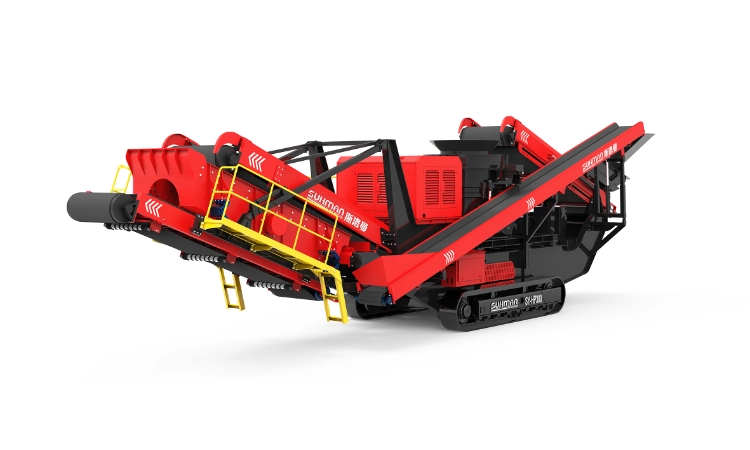
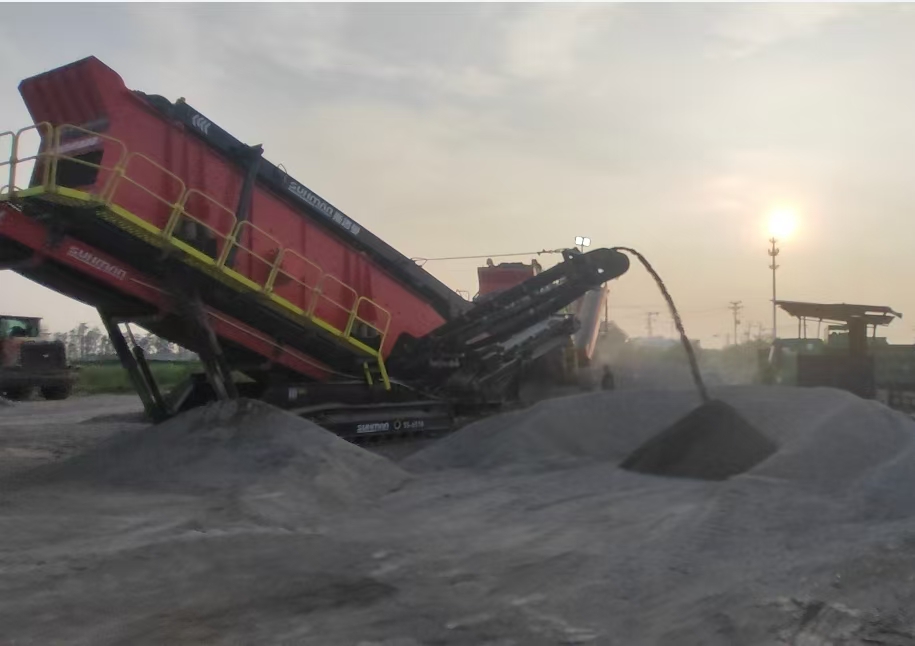
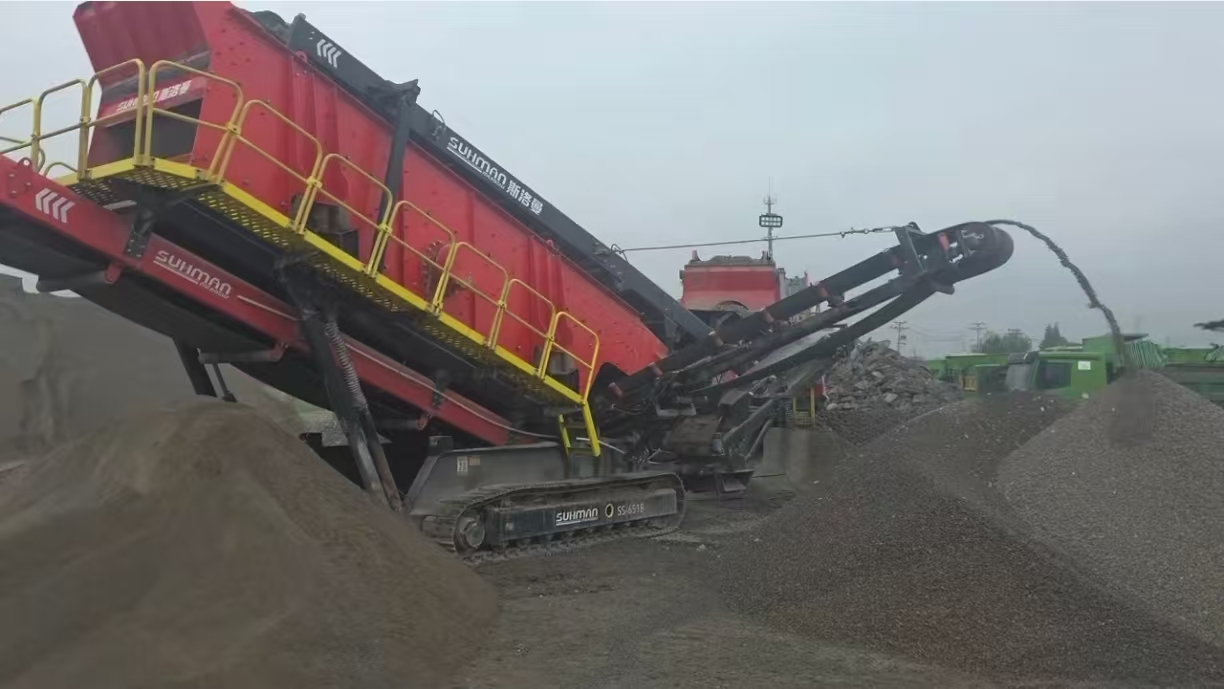
The spring rain had just stopped, and the air was still slightly damp. At the foot of the distant mountains, a red tracked mobile crushing machine and a screening machine were operating side-by-side, the conveyor belt continuously outputting processed stone.
"These are the Dainamu SF-380 and SS-7018 machines we bought in 2023. They've been running for almost three years now," said Old Chen, who has been in the construction aggregate business in Hangzhou for over a decade. "Last week you said you'd bring a new customer to visit, and I was thinking, 'This equipment is so old, what's there to see?' But when they saw the operating data, they immediately said they wanted to order the same model." I smiled. "Old Chen, your equipment isn't old at all. I just saw it; it's practically brand new." This wasn't just polite talk. Three days ago, I had indeed brought a customer from northern Shaanxi to inspect this place. The client had compared five or six manufacturers and was hesitant, but after seeing Lao Chen's production line, he signed a letter of intent with us that very afternoon.
In this article, I'll clearly explain the actual situation of this production line, its operating data, and the issues the client was most concerned about. If you're also in the construction aggregate business, or planning to buy mobile crushing equipment, I hope this will provide some reference.
I. Why did the client choose a mobile crusher?
Lao Chen's site is located in the mountainous area of Jiande, Hangzhou. When he acquired this mining site in 2023, he faced two choices:
- Fixed production line: High investment, long infrastructure construction period, but stable production capacity.
- Mobile crushing equipment: Relatively low investment, can start working immediately upon arrival, suitable for scattered mining sites.
"I did the math," Old Chen told me. "This mine has reserves of about 1.5 million tons. According to my production capacity plan, it will be mined out in about three years. If we built a fixed production line, the infrastructure alone would take two or three months. By the time it's operational, the ore will almost be depleted. Mobile equipment is different; you can just tow it over and use it, and it can move with you to different locations." Furthermore, environmental inspections in Hangzhou are strict, and the approval process for fixed production lines is lengthy. Mobile equipment is relatively flexible, and compliance costs are lower.
In March 2023, Old Chen purchased a Dainamu SF-380 mobile impact crusher and an SS-7018 mobile screening machine, and officially started production in April. It ran for a full three years, until April 2026.
II. Production Line Configuration and Output
Equipment Combination:
SF-380D Tracked Mobile Impact Crusher
SS-7018 Tracked Mobile Vibrating Screen
Feed: Mixed rock aggregate, maximum feed size 500mm
Output Specifications (Four Finished Products):
0-5mm (Made Sand)
5-10mm (Small Stones)
10-20mm (Medium Stones)
20-35mm (Large Stones)
Capacity: Average 200 tons/hour, daily output 1600-2000 tons (calculated based on 8-10 hours)
Old Chen told me that his site mainly supplies concrete mixing plants and highway construction projects around Hangzhou, which have strict requirements for stone specifications. The Sloman equipment has high screening accuracy, clearly separating the four types of materials, and controlling the powder content to within 5%, so the mixing plant's acceptance is basically without problems.
III. Real Data from Three Years of Operation
During this visit, I specifically asked Mr. Chen for three years of operational records. The following is a summary of the data:
- Production Capacity
"Production capacity has indeed decreased slightly, but the decline is very small," Mr. Chen said. "Over three years, the hourly output has decreased from 210 tons to 190 tons, about 10%. I can accept this; after all, the equipment is running, and wear and tear is inevitable. The key is stability. It can't be 200 tons today and 150 tons tomorrow; otherwise, I wouldn't be able to plan the production schedule."
- Wear Part Lifespan and Replacement Costs
This is one of the issues that customers are most concerned about. The core wear parts of a mobile impact crusher are the hammer plates and impact liners, while for a screening machine, it's mainly the screen.
"I usually replace the hammer every 800 hours or so," said Lao Chen. "It's not that it's unusable, but I proactively replace it at that time. Why? Because when it wears down to a certain extent, the content of needle-like and flaky particles in the output increases, affecting the quality of the stone. This is a long-term business for me; I can't ruin my reputation just to save a little money on spare parts." Over three years, the total cost of wear-resistant parts has been around 300,000 yuan, which translates to about 1.5-2 yuan per ton of stone. Chen said this cost is considered low to medium in the industry. He had previously used equipment from another brand, where the spare parts had shorter lifespans and the costs were actually higher.
- Hydraulic and Electrical Systems
The hydraulic system is the core of the mobile equipment and also a high-risk area for failure. Old Chen's line performance:
Hydraulic oil change: every 1000 hours, 8 times in 3 years
Hydraulic failures: 0 (no downtime caused by the hydraulic system)
Electrical failures: 2 (one was a loose sensor, the other was aging wiring, both minor issues)
"I haven't touched the hydraulic system," Old Chen said. "I just change the oil on time, and that's about it. The electrical system replaced a sensor last year, which took half an hour and didn't cause any delays."
- Fuel consumption and operating costs
The SF-380 uses a diesel generator set, and fuel consumption is another key concern for customers.
Average fuel consumption: Approximately 20 liters/hour (fluctuates depending on load)
Diesel cost: Calculated at 7.5 yuan/liter, approximately 150 yuan/hour
Fuel cost per ton of material: Approximately 0.8-1 yuan/ton
"Regarding fuel consumption, I think it's reasonable," said Lao Chen. "This is an impact crusher, which inherently consumes more power than a jaw crusher, but it has a larger crushing ratio and produces crushed material in one pass, so overall it's not a loss."
IV. Last Week's Visit: Why Did the New Customer Place an Order on the Spot?
Last Wednesday, I brought a customer from northern Shanxi to Lao Chen's facility for an inspection.
Upon arriving, the customer didn't rush to ask us any questions. He first walked around the equipment twice, and then chatted with Lao Chen for over half an hour. I gathered a few key points:
- Equipment Appearance: "Your equipment has been running for three years, but it looks almost new." "I maintain it regularly, replacing what needs replacing and cleaning what needs cleaning. The appearance is fine."
- Operating Noise: "Is the noise level high?" "It's alright. I live about two kilometers from the village, and I haven't received any complaints."
- Dust Control: "Environmental inspections are strict. How do you handle the dust?" "I added a dust suppression spray, and the equipment itself is well-sealed, so there are basically no problems."
- After-Sales Service: "How is Dainamu's after-sales service?" "They respond quite quickly. Once, there was a hydraulic pipe leak, and someone came to replace it the next day after I called." After our conversation, the client told me, "Mr. Chen, this production line is indeed excellent. It's been three years, and the equipment is in good condition with stable production capacity. I don't need the cheapest option; I need something reliable. Give me a quote based on this configuration." That afternoon, we signed a letter of intent. Once the site permits are completed on his end, we'll place the formal order.
Old Chen later told me, "Actually, I didn't deliberately say anything nice, just the truth. Whether the equipment is good or not, you'll know after three years of use. But since I helped you guys, you have to treat me to a meal."
V. Mobile Counter-Strike Breaker vs. Fixed Line: What's Old Chen's View?
At this point, I asked Old Chen, "If you could choose again, would you still choose the mobile equipment?" Old Chen thought for a moment and said,
"Yes. Why? First, my mine has limited reserves; it'll be gone in a few years. Mobile equipment is flexible; it can be used in a different location. Second, the investment is small, and the return on investment is quick. My line broke even in about 10 months. Third, the approval process is simple, and there's less environmental pressure."
"But mobile equipment also has disadvantages," he added, "First, the production capacity is not as high as a fixed line. Mine is 200 tons/hour, while a fixed line can easily reach 500 tons/hour." "First, the cost is over 1 ton. Second, the cost of spare parts is slightly higher because the spare parts for mobile equipment need to be lightweight, requiring higher material standards. Third, the requirements for operators are higher, since the equipment needs to be moved frequently." "Overall," Lao Chen summarized, "if you have a large mine and operate long-term, a fixed line is more cost-effective. If you have a small or medium-sized mine, scattered mining sites, or like me doing engineering projects, mobile equipment is more suitable."
VI. Some suggestions for friends preparing to buy equipment
Based on Lao Chen's case and the clients I've encountered over the years, I've summarized some suggestions:
- Don't just look at the price, look at the overall cost. The equipment price is only the first step; there are also spare parts, fuel consumption, maintenance, and labor costs. Some manufacturers offer cheap equipment, but expensive spare parts and shorter lifespans, making the final cost more expensive.
- Always look at actual operating cases. Parameters can look impressive, but how well it actually performs can only be known by using it. Like the Shaanxi client, visiting existing customer sites and talking to actual users is more useful than listening to a salesperson for an hour.
- Focus on After-Sales Service Network
Mobile equipment needs to work; even a day of downtime results in losses. Does the manufacturer have a service network in your area? What is their response speed like? Are spare parts in stock? These are all things to clarify in advance. - Choose Equipment Type Based on Your Needs
Hard Rock (Granite, Basalt): Jaw Crusher + Cone Crusher
Medium-Hard Rock, Construction Waste: Impact Crusher
Sand Making: Dedicated Sand Making Machine
Old Chen's site is a mixture of rocks with medium hardness, so an impact crusher is suitable. If it were granite, the impact crusher's hammers would wear out quickly, making it uneconomical. - Reserve Spare Parts Inventory
It's recommended to keep a set of commonly used spare parts (hammers, liners, screens, filter cartridges) on hand to avoid production delays due to waiting for spare parts. Sloman will include a set of commonly used spare parts with the shipment, but for long-term operation, it's still advisable to keep some on hand.
VII. A Few Final Words
Having worked in this industry for over a decade, I've seen too many customers buy equipment solely for its low price, only to regret it after a year. I've also seen some customers who initially thought it was a bit expensive, but after three to five years, they found the overall cost was actually lower.
Equipment is meant to work, not just sit there. Stability, reliability, and after-sales support are more important than price.
Old Chen's production line has been running for three years with stable capacity, low failure rate, reasonable parts lifespan, and excellent after-sales service. I believe this is the standard for good equipment.
If you're also considering mobile crushing and screening equipment, welcome to visit Old Chen's production line in Hangzhou, or visit other customers' sites. The quality of the equipment is best judged on-site.
Consultation Hotline: +86 13655601121 (WhatsApp)
Email: suhmanhf@gmail.com chinadainamu@gmail.com
Production Base: No. 43 Tangkou Road, Feixi County Economic Development Zone, Hefei City, Anhui Province