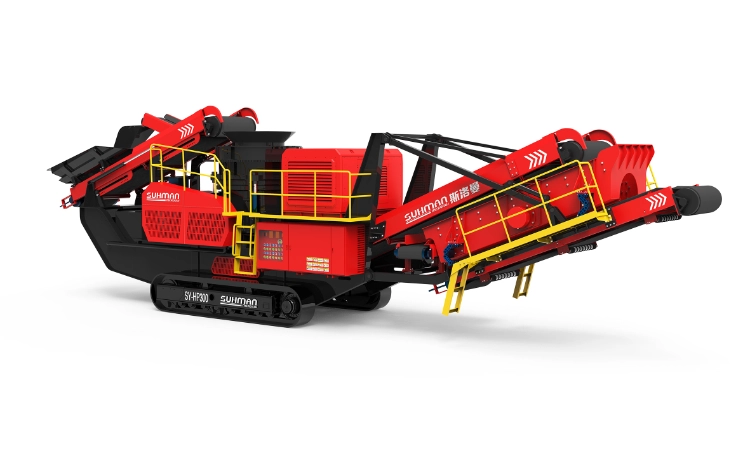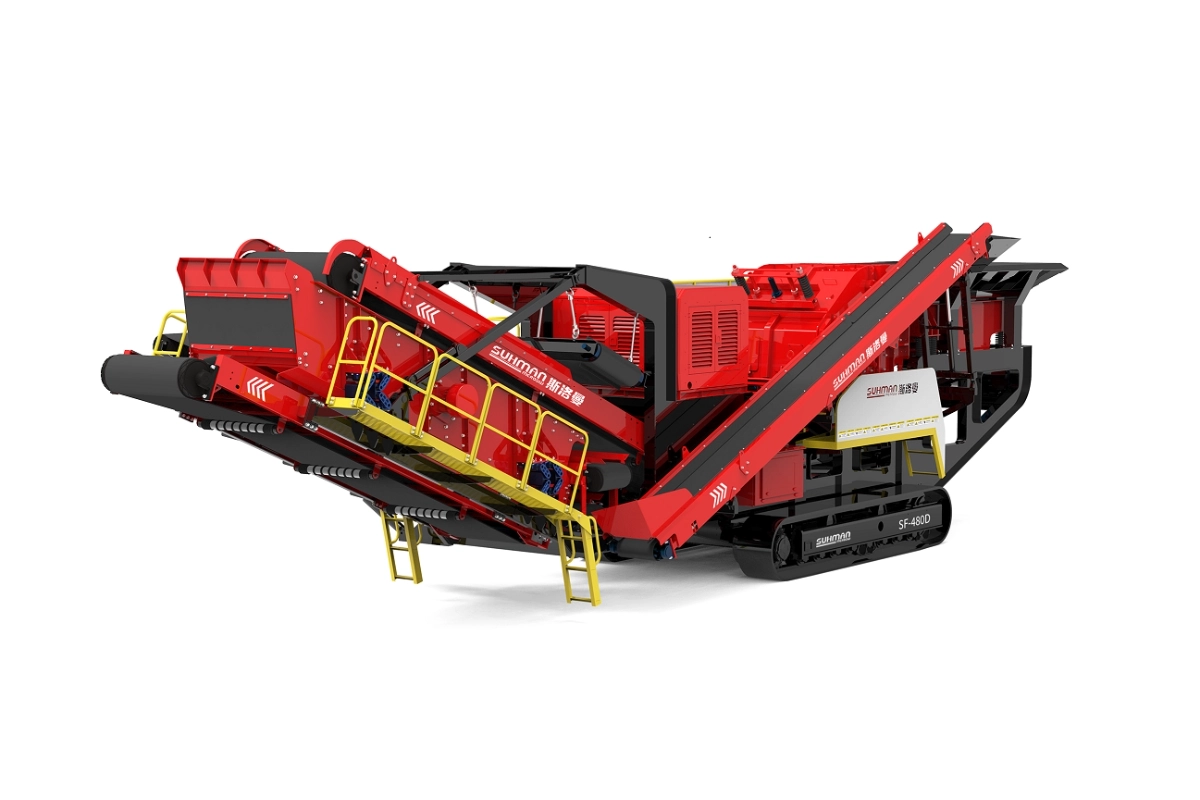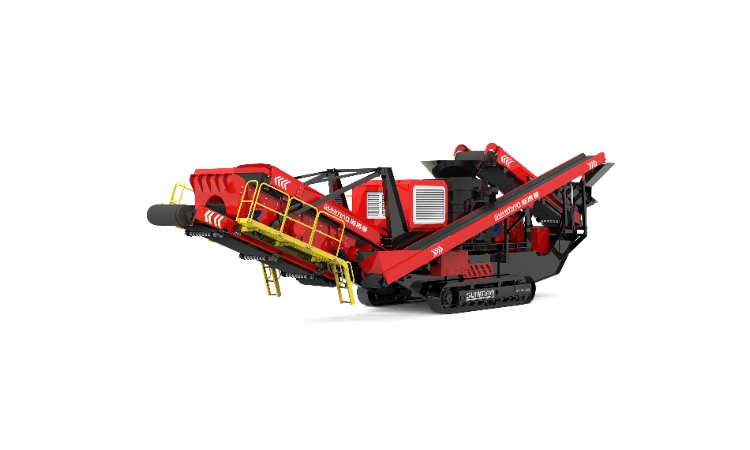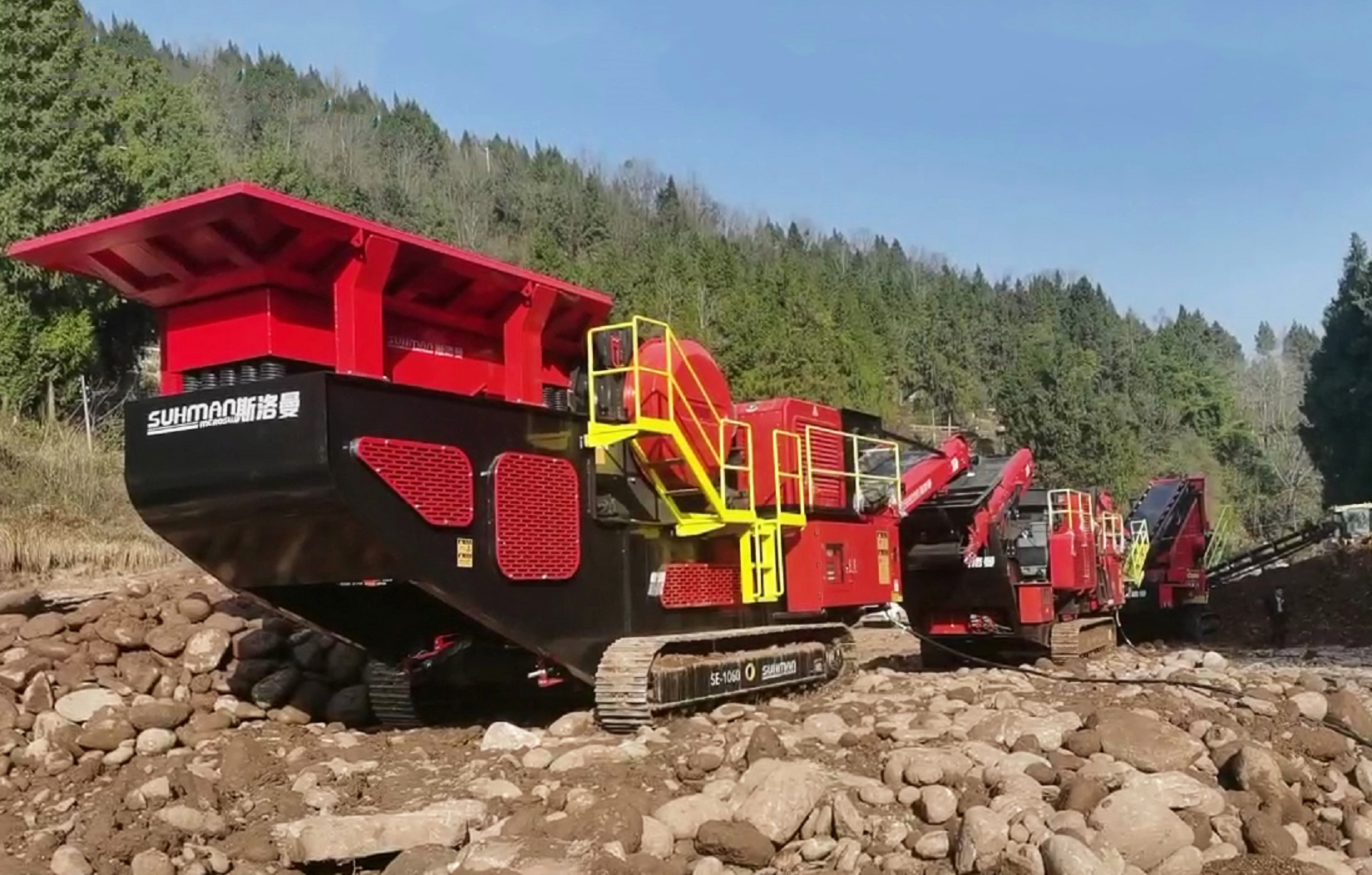
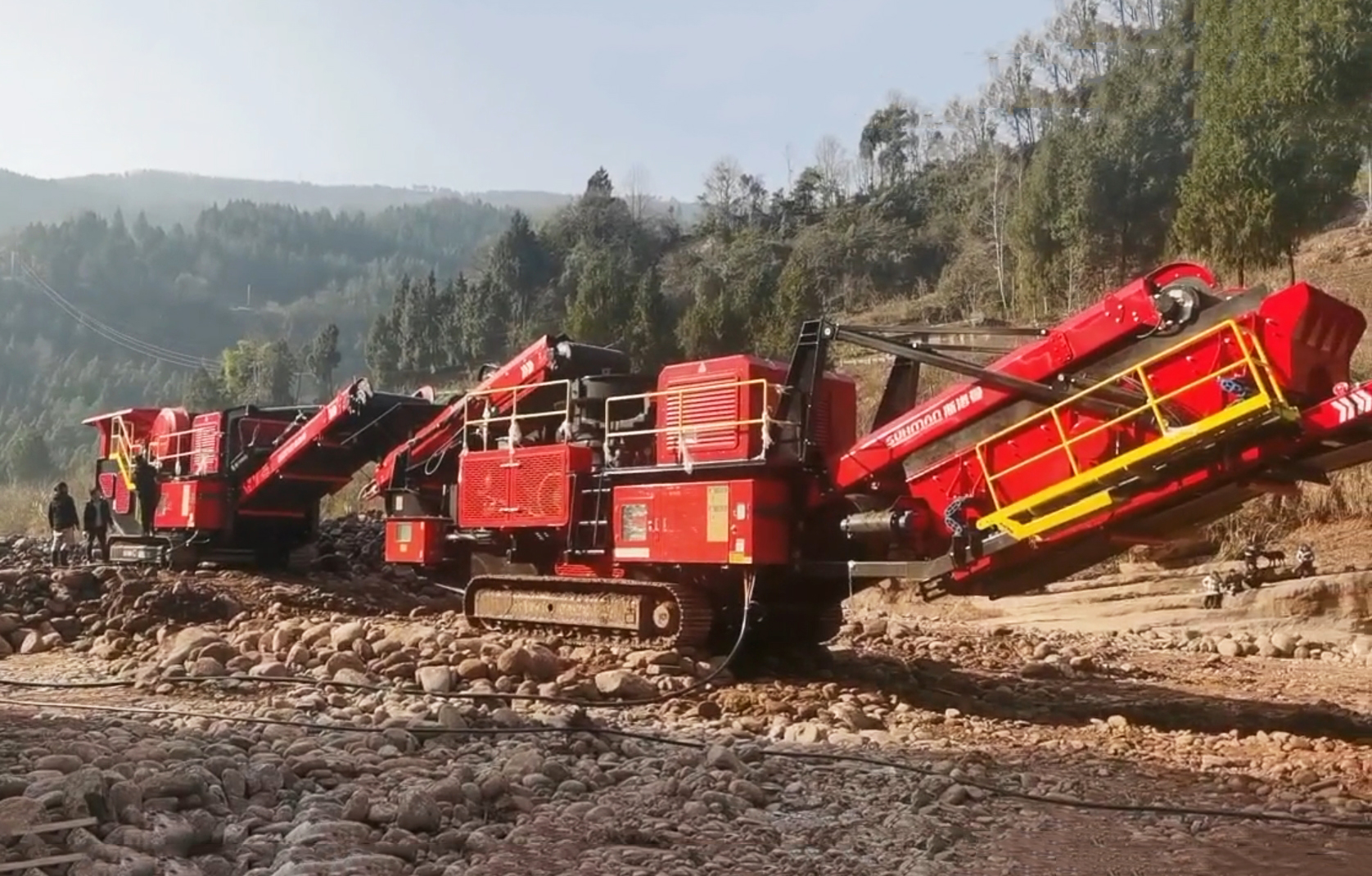
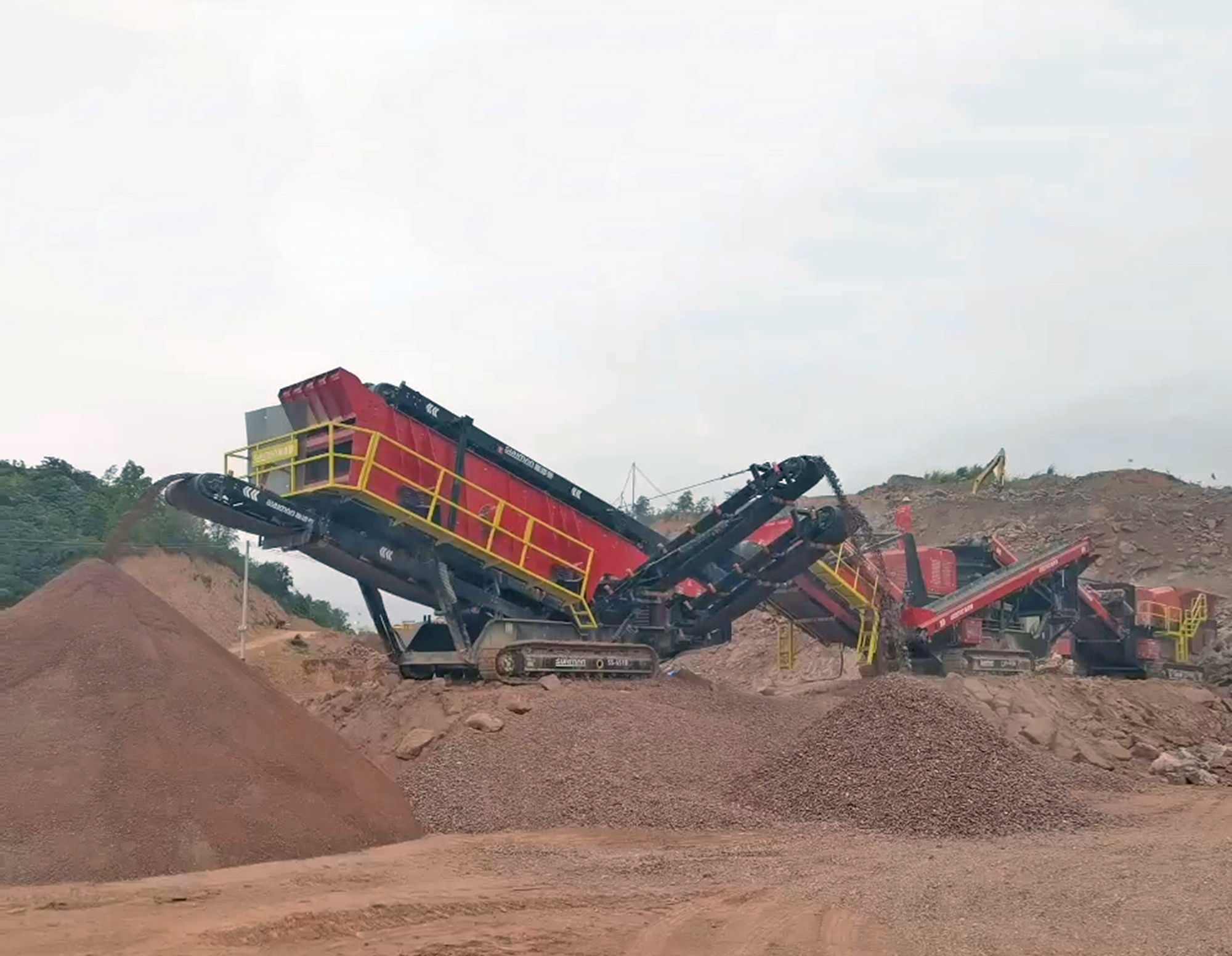
In the remote mining areas of northern Guangdong, a tracked mobile crushing plant is operating smoothly. A loader feeds 750mm granite blocks into the feed inlet. After passing through a jaw crusher, cone crusher, and vibrating screen, three conveyor belts continuously output three grades of finished aggregate: 0-5mm manufactured sand, 5-13mm small stones, and 13-31.5mm large stones.
This is a granite and pebble hard rock crushing production line customized by DAINAMU for a large mine in Guangdong. Since its commissioning six months ago, the equipment has maintained a stable output of 200-220 tons per hour. The service life of its wear parts is more than 40% longer than the industry average, and the multi-cylinder hydraulic cone crusher demonstrates a significant advantage in processing high-hardness materials.
This article avoids discussing parameter stacking, focusing instead on the technical details and real data from actual operation. If you are struggling with high wear, low capacity, and frequent downtime in hard rock crushing, you may find some helpful information here.
I. Industry Pain Points in Hard Rock Crushing: Why Do Many Equipment Sets Fall Apart?
Mines in Guangdong province are characterized by a predominance of granite, pebbles, and basalt, all characterized by high hardness, high silica content, and strong abrasiveness. These materials cause significant wear and tear on crushing equipment, leading many customers to report frequent problems shortly after purchase.
Short lifespan of wear parts is a common issue. One customer told us that their previous equipment required replacement of jaw crusher teeth plates in less than 300 hours, and cone crusher liners only lasted around 500 hours. This not only results in high spare parts costs but also frequent downtime for replacements, significantly increasing the overall cost per ton of material.
Inadequate cone crusher chamber design. Hard rock crushing is most vulnerable to over-crushing and material blockage. Some manufacturers copy soft rock designs for their cone crushers, causing excessive material retention within the chamber, leading to over-crushing, reduced capacity, and high energy consumption.
Insufficient equipment frame thickness. Mobile equipment operates in high-vibration environments for extended periods, and the frame thickness directly determines its lifespan. The industry standard frame thickness is 14-16 mm, and cracking and deformation are common after long-term operation.
The hydraulic system suffers from poor stability. The core of a multi-cylinder hydraulic cone crusher is its hydraulic control system. Some manufacturers use assembled hydraulic stations, resulting in large pressure fluctuations and slow overload protection response. If uncrushable materials enter, the main unit is easily damaged.
Diesel consumption remains high. Tracked mobile equipment is typically equipped with diesel generator sets, and fuel consumption is a major contributor to operating costs. Some equipment has inefficient hydraulic systems, leading to prolonged high-load engine operation and diesel consumption per ton of material increasing by 20%-30%.
Recognizing these industry pain points, DAINAMU has made targeted technological upgrades when developing hard rock crushing equipment.
II. Technical Details of DAINAMU's Hard Rock Crushing Solution
- High-chromium wear-resistant materials extend lifespan by over 40%. Wear-resistant parts are "consumables" in hard rock crushing and a major contributor to operating costs. DAINAMU, in collaboration with an Austrian technical team, has developed a series of high-chromium alloy wear-resistant materials.
Jaw crusher jaw plates are made of high-chromium cast iron with a chromium content of 26%-30% and a hardness of HRC58-62. Compared to traditional high-manganese steel, their wear resistance is improved by more than 50%. In a field test at a granite quarry in Guangdong, a set of jaw plates achieved a service life of 800-1000 hours, approximately 1.5 times the industry average.
The cone crusher's jaw and crushing wall utilize a high-chromium alloy + composite inlay process, with hard alloy blocks embedded in key wear areas, further extending their service life. Customer feedback indicates that, at the same output, the replacement frequency of wear parts has decreased from once a month to once every two months, resulting in a 35% reduction in spare parts costs.
The extended lifespan of wear parts not only reduces spare parts costs but, more importantly, reduces downtime for replacements. Assuming a reduction of 2 days of downtime per month per machine translates to over 20 extra days of production per year, with the increased capacity benefits far exceeding the savings on spare parts.
- Multi-cylinder hydraulic cone crusher, designed for hard rock
When processing high-hardness materials such as granite and pebbles, cone crushers offer advantages over impact crushers. The DAINAMU SY-HP series multi-cylinder hydraulic cone crusher features several optimizations specifically for hard rock crushing.
Multi-cylinder hydraulic system: Compared to a single-cylinder design, the multi-cylinder hydraulic system provides more uniform pressure distribution and greater crushing force. The SY-HP300 model is equipped with 8 hydraulic cylinders, achieving a total crushing force of 1200 tons, easily handling hard rock with a compressive strength exceeding 300MPa.
Laminated crushing chamber design: Utilizing an optimized laminated crushing principle, the material forms a "stone-on-stone" effect within the chamber, crushing along natural fissures. This reduces equipment wear while producing a fuller finished particle shape with a needle-like/flaky content of less than 5%, meeting the requirements of high-speed rail, highways, and other high-end projects.
Intelligent overload protection. The hydraulic system is equipped with a pressure sensor. When an uncrushable object (such as an iron block) enters the crushing chamber, the hydraulic cylinder automatically releases, the moving cone descends to expel the foreign object, and then automatically resets. The entire process is completed within 3 seconds, requiring no manual intervention, significantly reducing the risk of equipment damage.
The discharge port is hydraulically adjustable. The size of the discharge port can be precisely adjusted via the hydraulic system with an accuracy of ±0.5 mm, eliminating the need for manual adjustment by stopping the machine. This saves significant time for customers who need to frequently adjust the finished product specifications.
In a cobblestone crushing project in Guangdong, the SY-HP300 multi-cylinder cone crusher achieved an output of 180-200 tons per hour, producing excellent particle shape. The commercial concrete plant reported that the workability of the concrete was significantly better than that of aggregates from other suppliers.
- 20mm thick high-chromium steel frame, vibration-resistant and crack-resistant. The industry mainstream frame thickness for mobile crushing equipment is 14-16 mm. DAINAMU insists on using 20mm thick high-chromium alloy steel. This 4-6mm difference, seemingly increasing costs, actually saves customers long-term operating costs.
Stronger vibration resistance. The 20mm thick frame has a lower natural frequency, offsetting the equipment's operating vibration frequency, avoiding resonance, and reducing the likelihood of cracking during long-term operation.
Better impact resistance. When breaking hard rock, large stones have strong impact force; the thick frame can absorb more impact energy, protecting internal components from damage.
High-chromium material is corrosion resistant. The hot and humid climate of Guangdong and the high salt content in coastal mining areas make ordinary steel prone to rust and corrosion. High-chromium steel has excellent corrosion resistance, significantly extending the equipment's service life.
Customers have compared the two; after two years of operation, equipment with a 16mm frame showed weld cracks and localized deformation, while the DAINAMU equipment with a 20mm frame remained as stable as ever.
- Optimized diesel consumption, lower operating costs. Tracked mobile equipment is usually equipped with diesel generator sets, and fuel consumption is a major part of operating costs. DAINAMU has made several optimizations in energy saving.
Improved hydraulic system efficiency. A load-sensitive hydraulic system is adopted, automatically adjusting flow and pressure according to actual needs to avoid energy waste. Compared to traditional fixed-displacement hydraulic systems, energy consumption is reduced by 15%-20%.
Intelligent engine control. Equipped with an electronically controlled diesel engine, it automatically adjusts speed and fuel injection quantity according to load, avoiding high fuel consumption under low load.
Reduced standby power consumption. When the equipment is in standby mode, the system automatically enters a low-power mode, minimizing diesel consumption.
III. Guangdong Mining Case Study, Real-world Operational Data
Project Background
This project is located in a large granite mine in Qingyuan City, Guangdong Province. The client is a well-known local building materials company that has long supplied aggregates to highways, railways, and commercial concrete plants in the Pearl River Delta region.
The mine's raw material is mainly granite with a compressive strength of 250-300MPa, high silicon content, and strong abrasiveness. The client's existing fixed production line had insufficient capacity, and increasingly stringent environmental requirements necessitated equipment upgrades.
Customer Needs
Capacity Requirements: 200-220 tons per hour, over 2000 tons per day, to meet the material supply needs of multiple engineering projects.
Finished Product Specifications: Three aggregate specifications: 0-5 mm manufactured sand, 5-13 mm small stones, and 13-31.5 mm large stones, with 13-31.5 mm accounting for the largest proportion, approximately 50%.
Particle Shape Requirements: Needle-shaped and flaky content less than 8%, meeting the standards for high-speed rail construction aggregates.
Environmental Requirements: Dust and noise levels must be controlled within national standards, without affecting the lives of surrounding villagers.
Relocation Needs: The mine has multiple mining faces, requiring equipment to be relocated every 3-4 months.
Equipment Configuration
To meet customer needs, DAINAMU offers the following mobile crushing and screening production line configurations:
SE-1060 Tracked Mobile Jaw Crusher: As a coarse crushing unit, it has a feed size ≤700 mm, an adjustable discharge port range of 50-150 mm, a feeder with pre-screening function, and fine material bypass to improve efficiency.
SY-HP300 Tracked Mobile Multi-Cylinder Hydraulic Cone Crusher: As a medium and fine crushing unit, it is equipped with an 8-cylinder hydraulic system, a crushing force of 1200 tons, and a layered crushing chamber type, suitable for hard rock crushing.
SS-7018 Tracked Mobile Vibrating Screen: Equipped with three layers of screens, with screen aperture sizes of 31.5 mm, 13 mm, and 5 mm, a screening capacity of 250 tons/hour, and a quick-change screen design.
A dust suppression spray system is installed at key dust-generating points such as the feed inlet, crushing chamber, and discharge outlet to effectively suppress dust.
The intelligent electrical control system is PLC-controlled, touchscreen-operated, and supports remote monitoring.
Operating Data: The equipment was put into operation in September 2025 and had been running stably for 6 months as of March 2026. The following are actual operating data provided by the customer:
Capacity: Actual operating output is 200-220 tons per hour, with a daily output of 2000-2200 tons, reaching the designed capacity. The customer stated, "I originally thought 200 tons per hour would be good, but I didn't expect it to be stable at this level; it exceeded my expectations."
Wear Part Life: Jaw crusher tooth plates have a lifespan of 800-1000 hours, and the cone crusher's grinding bowl and crushing wall have a lifespan of 1200-1500 hours. Compared to previously used equipment in the same industry, the wear part lifespan has been extended by 40%-50%.
Finished Product Quality: The three aggregate specifications are reasonably graded, with a needle-like/flaky content of 3%-5% and a powder content of 2%-4%, fully meeting the standards for high-speed rail construction aggregates. The ready-mix concrete plant reported good workability, which led the client to secure long-term supply contracts for two high-speed rail projects.
Environmentally, dust concentration is controlled below 4 mg/m³, and noise levels are 82 decibels, meeting national standards. No complaints have been received from surrounding villagers in the six months since production began.
Relocation efficiency: A relocation was completed in January 2026, with the entire process from dismantling, loading, transportation to resuming production taking only 3 days. The customer said, "If it were a fixed line, relocation would take at least half a month and cost tens of thousands more in disassembly and assembly fees." Customer Review
"Choosing DAINAMU was one of the best decisions we've ever made," said the customer manager. "The equipment is indeed robust; the 20mm frame is much more stable than the previous 16mm one, with less vibration and lower noise. The high-chromium wear-resistant parts have a long lifespan, significantly reducing spare parts costs. The multi-cylinder cone crusher easily processes granite, with stable production capacity and good particle shape. After-sales service is also excellent, with quick response to problems. This equipment is highly recommended."
IV. Key Points to Consider When Selecting Hard Rock Crushing Equipment
If you are considering purchasing hard rock crushing equipment, the following suggestions are for your reference:
First, consider the main unit model. For the same type of crusher, the size determines the production capacity and wear part lifespan. For hard rock crushing, it is recommended to choose a larger main unit, as it has a lower load and a longer lifespan.
Second, consider the wear part material. Although high-chromium alloy wear parts are more expensive, they have a longer lifespan and require less frequent replacement, resulting in a lower overall cost. Don't just look at the unit price of spare parts; calculate the cost of wear-resistant parts per ton of material.
Third, check the frame thickness. A frame thickness of 18mm or more is recommended for mobile equipment, and 20mm is best for hard rock crushing. Frame cracks result in high repair costs and delays; a one-time investment is more cost-effective.
Fourth, check the hydraulic system. Multi-cylinder hydraulic cone crushers are more advantageous for handling hard rock. Choose brand-name hydraulic systems with stable pressure and reliable overload protection.
Fifth, check diesel consumption. Fuel consumption for tracked mobile equipment is a long-term cost; it's recommended to ask the manufacturer for actual measured data, not just theoretical values.
Sixth, check after-sales service response. Hard rock crushing equipment wears out quickly, so spare parts supply must be timely. Choosing a manufacturer with a local service network can reduce downtime.
Finally, in conclusion, hard rock crushing is a technical job; you can't just buy any equipment and do it well. DAINAMU has been deeply involved in the mobile crushing and screening industry for many years, always adhering to the philosophy of "building a high-end brand with military-grade quality." We don't compete on price, because good materials, good processes, and good service all have costs. We compete on value—using better equipment to help our clients reduce operating costs, improve production efficiency, and create more revenue.
This case study of the Guangdong mine is just one of DAINAMU's many hard rock crushing projects. In Fujian, Jiangxi, Hunan, Guangxi, and other regions, many more clients are using DAINAMU equipment to provide high-quality aggregates for infrastructure construction.
If you are considering a hard rock crushing project, please contact us. We can arrange a visit to a nearby production site to see the equipment in operation and hear real feedback from other clients.
The quality of our equipment is judged by our users.
Consultation Hotline: +86 13655601121
Email: suhmanhf@gmail.com
Production Base: No. 43 Tangkou Road, Feixi Economic Development Zone, Hefei City, Anhui Province
DAINAMU—Building a high-end brand for hard rock crushing with military-grade quality.