
Jaw crushers, as the name suggests, are always chewing.
Imagine a refrigerator-sized rock blasted from a quarry. It's granite—hard and stubborn, a headache for ordinary equipment. Then a machine grabs it without hesitation, squeezing it with enough force to crush steel, producing usable gravel.
That's a jaw crusher. And it's been in this business for almost two hundred years.
The jaw crusher is the absolute mainstay of the primary crushing stage. It's the first piece of equipment the rock encounters after leaving the quarry, and the "tone setter" of the entire production line. If the right jaw crusher is chosen, the subsequent cone crusher, impact crusher, and screening machine will all run smoothly; if the wrong jaw crusher is chosen, the entire line will suffer.
This article will explain clearly: how jaw crushers work, why some can last for over a decade while others break down after a few months, and the most crucial details that most buyers overlook.
How Jaw Crusher Works: Simple Principle, Brutal Operation
The principle is actually quite simple, almost "basic." A jaw crusher has two jaw plates—one fixed and one movable. The movable jaw plate is driven by an eccentric shaft and swings back and forth. When the jaw plates close, the stone is squeezed between the two plates, breaking it apart. When the jaw plates separate, the fragments fall downwards. This action is repeated 200 to 300 times per minute.
Geometric shape is important. The two jaw plates form a V-shaped cavity, wider at the top and narrower at the bottom. The space decreases as the material moves downwards, being repeatedly squeezed until it is small enough to exit from the bottom discharge port. This bottom gap is called the "closed-side discharge port" (CSS).
The science behind compression: the stone's tensile and compressive strength. Granite can withstand a compressive force of 200 MPa. The jaw crusher applies forces exceeding this limit, causing the stone to fracture along natural fissures. What comes out is not powder, but cubic, angular aggregate—this type of stone sells for a higher price on the market.
Five Core Components: Determining the Lifespan of a Jaw Crusher
Any machine can be made by simply piecing together two steel plates and calling it a crusher. But whether a machine lasts ten years or only two months in the repair shop depends entirely on these five components. Let's discuss them one by one.
- Jaw Plates (Tooth Plates) – The Real Working "Teeth"
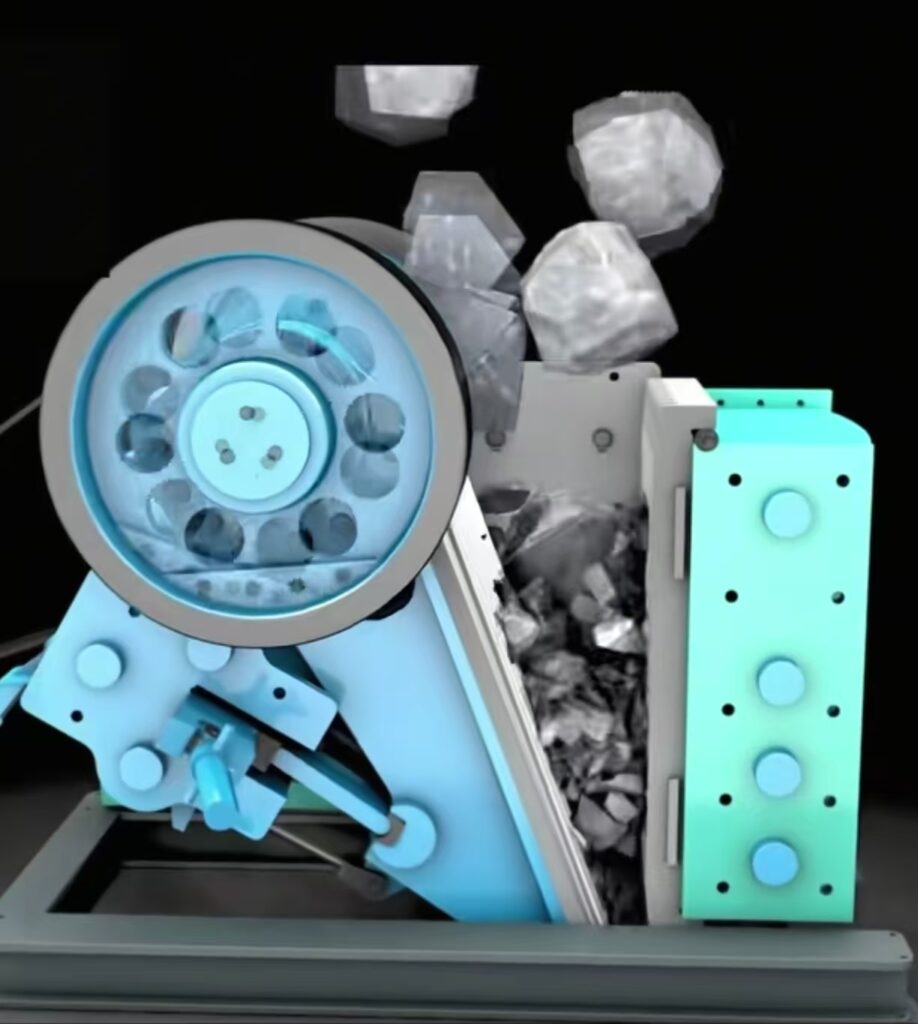
Jaw plates are the wear-resistant parts that directly contact the stone. They are usually made of high-manganese steel – with a manganese content generally between 14% and 18%. The higher the manganese content, the better the work hardening performance: the harder the stone hits, the harder the plate surface becomes.
What most buyers don't check: The manganese content is not uniform throughout the entire jaw plate. Cheap jaw plates use low-manganese steel at the bottom to save money, resulting in uneven wear and premature wear in some areas. Good jaw plates have a consistent composition from start to finish.
Dainamu's approach: We use 18% manganese steel, with the carbon content controlled at around 1.2%, and achieve the optimal balance of hardness and toughness through heat treatment. Each jaw crusher model has a different tooth profile—the SE-1060 and SE-650D have different tooth profiles because they handle different feed sizes and materials. For ultra-hard rock conditions, we also offer bimetallic composite jaw plates with an ultra-hard surface and a highly tough bottom.
- Thrust Plate (Toggle Plate)—The Crusher's "Fuse"
The thrust plate is the simplest and most misunderstood part. It's a small steel plate that connects the movable jaw plate to the frame. Its function is to transmit crushing force—and actively break when uncrushable materials (such as shovel teeth, drill rods, and rebar) enter the crushing chamber.
That's right, the thrust plate is designed to break. It's the jaw crusher's mechanical fuse. When uncrushable materials enter, the thrust plate breaks, the machine stops, and it protects the frame, shafts, and bearings from damage.
What most buyers don't check: The steel grade and heat treatment of thrust plates vary greatly. Cheap thrust plates use low-carbon steel, which won't break when bent—failing to provide protection in critical moments. Or they're too brittle and will break during normal operation. Dainamu's approach: We use 45# medium carbon steel, undergoing strictly controlled heat treatment to ensure the thrust plate breaks under a preset force value. For larger models, we also offer hydraulic thrust plates (hydraulic discharge port adjustment system). When encountering uncrushable objects, the hydraulic cylinder automatically retracts, and automatically resets after removing the foreign object—no need to stop the machine to replace the plate.
- Eccentric Shaft—The Heart of the Machine
The eccentric shaft is the crankshaft that converts the motor's rotational motion into the jaw plate's oscillation. It is the most critical component of the jaw crusher. Once the shaft fails, the entire machine is rendered useless.
The eccentric bearing is subjected to enormous alternating loads—bending, torsion, and impact forces—hundreds of times per minute, 24 hours a day. It must be manufactured using forged alloy steel, typically 42CrMo or equivalent, and heat-treated to achieve high fatigue strength.
What most buyers don't check: The forging process is crucial. Cheap shafts are cast, not forged. Casting may result in internal porosity and inclusions, which can become crack initiation points under alternating loads. Forged shafts have uniform grain size and significantly stronger fatigue resistance.
Dainamu's approach: All our eccentric shafts are integrally forged from 42CrMo alloy steel, with a core hardness of 28-32 HRC after heat treatment and surface hardening. The eccentricity is precision machined to ensure uniform jaw plate movement across the entire cavity width, preventing uneven wear and material accumulation.
- Bearings – Saving money here is most costly.
Bearings are where cheap crushers become expensive. The main bearing of a jaw crusher withstands extreme loads, impacts, and vibrations. It must simultaneously withstand the radial load generated by the crushing force and the axial load generated by the rotation of the eccentric shaft.
Jaw crushers typically use spherical roller bearings – SKF, FAG, or equivalent brands. These bearings can withstand misalignment and heavy loads. The bearing housing must be precision machined and well-sealed to prevent dust ingress.
What most buyers don't check: the bearing fit precision and the bearing housing machining precision. Even a slight deviation in the bearing housing can cause the bearing to overheat and fail prematurely. Dust sealing is equally crucial – crusher dust is abrasive, and if it gets into the bearings, it's devastating.
Dainamu's approach: We use SKF or FAG spherical roller bearings, mounted in precision-machined cast steel bearing housings. With precision controlled to ISO 6 tolerances, we employ multi-layer labyrinth seals + grease flushing to ensure dust cannot enter and grease does not leak. The result: bearing life reaches or exceeds the manufacturer's stated L10 rated life.
- Frame – The Skeleton Supporting Everything
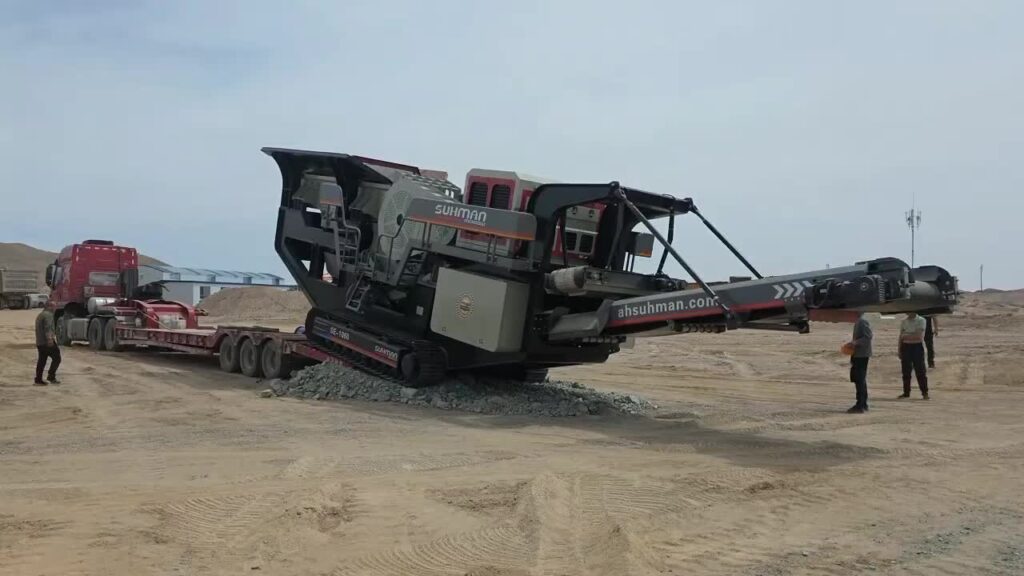
The frame supports all components and bears the crushing force. It is the largest steel structural component of the entire machine, bearing the most severe stress concentration.
There are two types of frames: welded frames (made of welded steel plates) and cast steel frames (cast as a single piece). Modern mobile jaw crushers mostly use welded frames because they are lighter and allow for optimized stress distribution. Cast steel frames are heavier but offer better vibration damping.
What most buyers don't care about: weld quality and stress relief. If the welded frame is not properly stress-relieved, cracks will develop over time at bearing housing connections, thrust plate seats, and other locations. Critical welds should undergo ultrasonic testing (UT) to ensure full penetration.
Dainamu's approach: Our mobile jaw crusher frame is welded from Q345 high-strength steel plates, with all critical parts welded to full penetration. Residual stress is eliminated after welding through vibration aging or heat treatment. Critical areas such as bearing housings, thrust plate seats, and side guard plates have increased plate thickness and internal reinforcing ribs.
Three types of jaw crushers: Which one do you need?
Not all jaw crushers are the same. The three main types differ in their jaw plate movement and applicable scenarios.
- Simple pendulum jaw crusher (Blake type) – Classic model
The simple pendulum jaw crusher has its movable jaw plate fixed at the top as a fulcrum, with the largest swing amplitude at the bottom. It provides more pronounced compression and less abrasion to hard rock.
Suitable for: Hard rock, granite, basalt, iron ore.
- Compound Pendulum Jaw Crusher (PE Type) – Modern Mainstream
The moving jaw of a compound pendulum jaw crusher is directly mounted on an eccentric shaft, allowing movement throughout the entire height of the jaw plates. This results in higher capacity and more uniform product particle size. Modern stationary and mobile jaw crushers primarily use this design.
Suitable for: General-purpose coarse crushing, suitable for various types of rock.
Dainamu Product Line: Our mobile jaw crushers (SE-650D, SE-1060, SE-1160) all adopt a compound pendulum design, optimized for lightweight and rapid deployment in mobile applications. The TZ6510 dual-core jaw crusher is our latest innovation – one machine with two crushing chambers, doubling capacity without increasing footprint.
Rule of thumb: If you are crushing hard rock (granite, basalt, iron ore) and need a reliable coarse crusher to handle large feed volumes, a jaw crusher is the best starting point. If your material is softer (limestone, coal) or you are recycling construction waste, an impact crusher may be more efficient.
Common Jaw Crusher Problems (and How to Avoid Them)
After visiting hundreds of construction sites and talking to countless operators, the following are the most frequent problems—and almost all of them are preventable.
Problem 1: Uneven Jaw Plate Wear
Cause: Material is not evenly distributed across the full width of the jaw plate. One side receives more material, while the other side is idle.
Solution: Install a proper feed distributor. Ensure the feed hopper fills the entire width of the jaw plate, not just the middle or one side.
Problem 2: Material Blockage in the Crushing Chamber
Cause: Feed rate is too fast, or the material is too wet or sticky. Material bridges within the chamber, stopping its flow.
Solution: Control the feed rate. Add a pre-screen or screening machine before the jaw crusher to remove oversized and fine powder. For sticky materials, increase the discharge opening and reduce the feed rate.
Problem 3: Too Much Fine Powder
Cause: Discharge opening is too small, or the jaw plate tooth shape does not match the material.
Solution: Adjust the discharge opening according to the target product size. Too much fine powder? Enlarge the discharge port or replace with a coarser jaw plate.
Problem 4: Frame Cracks
Causes: Poor weld quality, inadequate stress relief, or overloading.
Solution: This is a manufacturing issue. Buy from manufacturers that have performed stress relief and weld flaw detection. Don't exceed the rated capacity.
Dainamu's Confidence: Money Invested in the Invisible Strategies
We can list a bunch of parameters. But parameters tell you why one jaw crusher lasts ten years while another fails after two. What truly matters are these:
Uncompromising Steel: Frame uses Q355B, shafts use 42CrMo, jaw plates use 18% manganese steel. No substitutions, no downgrading, batch testing.
No Cheap Bearings: SKF/FAG bearings, precision bearing housings, reliable seals. It may seem mundane, but it's the difference between a machine that runs continuously and one that's constantly in the repair shop.
Hydraulic System: Our hydraulic discharge port adjustment and hydraulic thrust plate system use sealed cylinders + overflow valves. No need to stop the machine, open the door, or manually adjust the discharge port with iron plates. Everything can be done in minutes on the control panel.
Quality inspection is thorough: Every part is inspected before assembly. Every complete machine runs unloaded for at least 4 hours before leaving the factory. No machine leaves the factory without being tested.
Spare parts don't keep you waiting: Jaw plates, thrust plates, bearings, and other wear parts are always in stock. If needed, they will be shipped within 48 hours. No need to wait weeks for production scheduling.
- How to inspect a jaw crusher before buying:
When comparing jaw crushers from different manufacturers, don't just look at the brochures; check these things:
Open the inspection door. Check the welds. Are they uniform? Has stress relief been done?
- Check the bearing brand. SKF, FAG, NSK—these are standard.
- Go to the operating site. Ask the operator how long the jaw plates will last. This number is more accurate than any parameter table.
- Check the hydraulic system. Is it a brand-name system with standard connectors, or self-made parts with non-standard parts?
One last thing: Jaw crushers – the cheap ones aren't cheap.
Jaw crushers are fixed assets. Cheap equipment saves money upfront but costs a lot later. Excellent equipment costs more upfront but is worry-free later. If you plan to operate for more than a year, the math will always pay off.
Dainamu's logic for jaw crushers is simple: the machine has to keep running. It's not because we're particularly noble, but because a machine that doesn't break down is the only one we recommend. In this industry, reputation is the only true currency.
If you're evaluating jaw crushers, send us your material parameters, capacity requirements, and site conditions. We'll tell you exactly what you need – even if it's not our machine.