
Do you want to know the core differences and advantages of single-cylinder vs. multi-cylinder systems?In the technical roadmap of mobile cone crushers, the hydraulic system is a key component determining equipment reliability, maintenance costs, and crushing efficiency. Currently, there are two main hydraulic designs on the market: single-cylinder hydraulic and multi-cylinder hydraulic. For heavy-duty applications such as mining, aggregate production, and construction waste recycling, multi-cylinder hydraulic cone crushers are becoming the preferred choice for an increasing number of specialized users.
[View Video]
I. What is a Multi-Cylinder Hydraulic Cone Crusher?
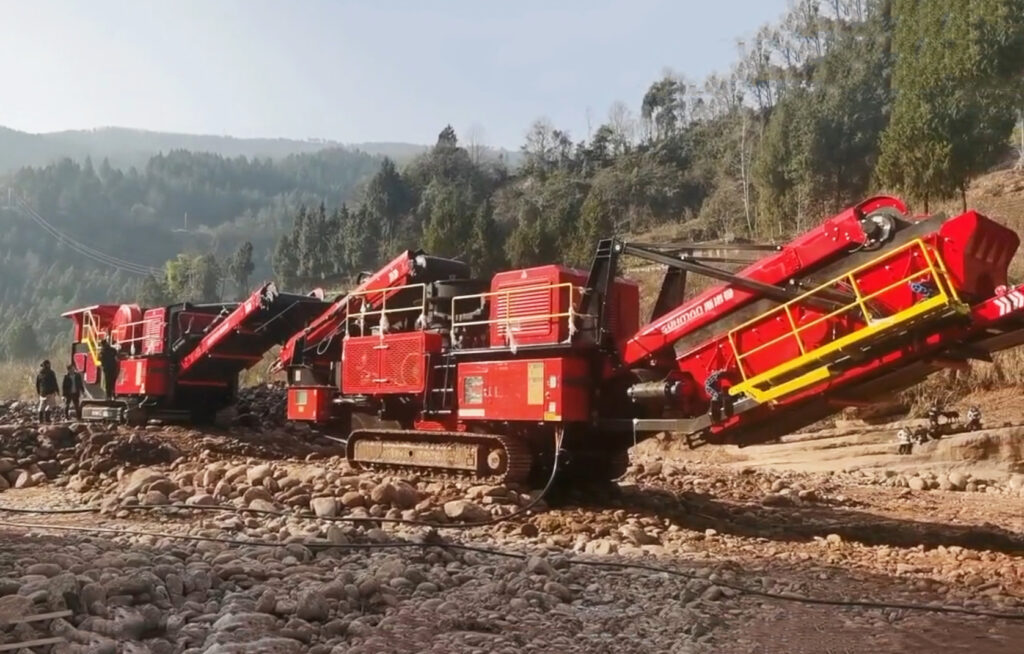
A multi-cylinder hydraulic cone crusher has multiple hydraulic cylinders (usually 4-8) arranged around the crusher frame. These cylinders work together to perform core functions such as discharge opening adjustment, overload protection, chamber clearing, and locking.
In contrast, a single-cylinder hydraulic cone crusher has only one main hydraulic cylinder at the bottom of the equipment, and all functions are performed by this single cylinder.
II. The core differences and advantages of single-cylinder vs. multi-cylinder systems.
| Comparison Dimensions | Single-Cylinder Hydraulic Cone Crusher | Multi-Cylinder Hydraulic Cone Crusher |
| Number of Hydraulic Cylinders | 1 (Bottom Main Cylinder) | 4-8 (Evenly Distributed Around the Frame) |
| Stress Distribution | Stress concentrated in a single cylinder | Stress evenly distributed across multiple cylinders |
| Discharge Opening Adjustment | Achieved through main cylinder lifting | Multiple cylinders lifting and lowering simultaneously for more precise adjustment |
| Overload Protection | Single-Cylinder Pressure Relief and Retreat | Multiple cylinders simultaneously depressurizing for smoother retreat |
| Crushing Force Transmission | Single-point stress, stress concentration | Multi-point stress, even stress distribution |
| Maintenance Complexity | Simple structure, easy maintenance | Complex structure, but single-cylinder failure does not affect the overall system |
| Applicable working conditions | Small to medium-sized, medium-hard materials | Large-scale, hard rock, continuous high-intensity operations |
III. Five Core Advantages of Multi-Cylinder Hydraulics
- Uniform force distribution, longer equipment lifespan
The biggest problem with single-cylinder design is stress concentration. All the crushing force acts on a single hydraulic cylinder, leading to accelerated wear of cylinder seals, cylinder deformation, and even breakage under long-term high load.
Multi-cylinder design evenly distributes the crushing force across 4-8 hydraulic cylinders, significantly reducing the load on each cylinder. This means:
2-3 times longer seal life
Signage deformation risk significantly reduced
Overall structural stability greatly improved
- More precise discharge port adjustment
The discharge port directly determines the particle size of the finished aggregate. The multi-cylinder hydraulic system, through the coordinated lifting and lowering of multiple cylinders, can precisely control the position of the moving cone, achieving an adjustment accuracy of ±1mm.
Single-cylinder systems, due to uneven force distribution, are prone to tilting during adjustment, leading to inconsistent discharge openings and affecting the uniformity of finished product particle size.
- More Reliable Overload Protection
When uncrushable materials (such as shovel teeth, drill rods, and reinforcing bars) enter the crushing chamber, the hydraulic system must quickly depressurize and retract to protect the equipment from damage.
The advantages of multi-cylinder systems are:
Simultaneous depressurization of multiple cylinders results in smoother retraction without impact. Automatic reset after retraction eliminates the need for machine shutdown. Single-cylinder systems are prone to uneven loading during retraction, causing the moving cone to tilt and jam.
- Higher Crushing Efficiency
Multi-cylinder hydraulic systems provide greater locking force, ensuring stable moving cone position during crushing and reducing ineffective vibration and energy loss. This means:
The material in the crushing chamber is more thoroughly crushed.
Higher output per unit of energy consumption.
Better finished product particle shape (higher cubic proportion).
- Fault Redundancy, Uninterrupted Production
Multi-cylinder systems have inherent fault redundancy capabilities. Even if one hydraulic cylinder fails, the others can maintain basic operation, buying time for maintenance.
If the main cylinder of a single-cylinder system fails, the entire machine must be shut down immediately. For continuously operating mines and aggregate production lines, downtime losses can reach tens of thousands of yuan per hour.
IV. Technical Highlights of Dainamu Multi-Cylinder Cone Crusher
Taking Dainamu's SY-HP300 and SY-HP400 multi-cylinder hydraulic cone crushers as examples:
Multi-cylinder hydraulic system: Evenly distributed around the frame, providing stable and reliable locking and yielding forces.
Fully hydraulic adjustment: Discharge port adjustment can be completed on the control panel without stopping the machine.
Automatic overload protection: When an uncrushable object is detected, the hydraulic cylinder automatically yields and automatically resets after removal.
SKF/FAG bearings: Ensure stable operation of the main shaft under extreme loads.
Laminated crushing principle: Materials are crushed by mutual compression within the crushing chamber, resulting in excellent finished particle shape.
V. Selection Recommendations: When should a multi-cylinder system be selected?
Recommended scenarios for multi-cylinder hydraulic cone crushers:
Crushing hard rocks such as granite, basalt, and river pebbles
High-intensity working conditions requiring continuous 24-hour operation
Strict requirements for finished aggregate particle size
Large-scale projects with an annual processing capacity exceeding 500,000 tons
Desire to reduce long-term maintenance costs
Scenarios suitable for single-cylinder hydraulic crushers:
Medium-hard materials (limestone, dolomite)
Small to medium-sized projects with an annual processing capacity of 100,000-300,000 tons
Short-term projects with limited budgets
VI. Summary
Multi-cylinder hydraulic cone crushers are superior to single-cylinder designs in all five dimensions: force distribution, adjustment precision, protection reliability, crushing efficiency, and fault redundancy. Although the initial investment is slightly higher, for users of hard rock crushing and long-term continuous operation, the total cost of ownership (TCO) of multi-cylinder systems is lower and the return on investment is faster.
If you are choosing a cone crusher for a mine, aggregate production line, or construction waste recycling project, multi-cylinder hydraulic is a wiser choice.
Need to know the specific models and prices of Dainamu multi-cylinder cone crushers?
Phone/WhatsApp: +86 15385175652
Mail: chinadainamu@gmail.com